


 English
 русский
Content
- 1 What Is an Air Cooled Condenser in Refrigeration
- 2 How an Air Cooled Condenser Works: Working Principle
- 3 Key Components of an Air Cooled Condenser
- 4 Air Cooled Condenser Capacity
- 5 Air Cooled Condenser Selection Guide
- 6 Air Cooled Condenser Applications
- 7 Air Cooled Condenser Efficiency
- 8 Air Cooled vs Water Cooled Condensers
- 9 Air Cooled Condenser Maintenance
What Is an Air Cooled Condenser in Refrigeration
An air cooled condenser is a heat exchanger that rejects heat from a refrigeration or air conditioning system's high-pressure refrigerant gas directly into the surrounding air, condensing it back into a liquid before it returns to the expansion valve to repeat the cycle. Because it uses ambient air rather than water as the cooling medium, an air cooled condenser eliminates the need for a water supply, cooling tower, or water treatment system — a major reason it's the default choice across commercial refrigeration, packaged air conditioning, and cold storage applications where water access, cost, or scaling and legionella risk make water cooled systems impractical.
In a typical refrigeration circuit, the air cooled condenser sits between the compressor and the expansion device, receiving hot, high-pressure refrigerant vapor from the compressor discharge line and releasing that heat to atmosphere before the now-liquid refrigerant continues through the system.
How an Air Cooled Condenser Works: Working Principle
An air cooled condenser works by forcing ambient air across a finned coil carrying hot refrigerant, transferring heat from the refrigerant to the air stream through the coil's tube and fin surface area. The process happens in three stages as refrigerant vapor moves through the coil:
- Desuperheating — hot refrigerant vapor entering the coil first cools from its discharge temperature down to its saturation temperature, releasing sensible heat without yet changing phase
- Condensing — as refrigerant continues cooling at constant saturation temperature, it changes phase from vapor to liquid, releasing the bulk of the total heat rejected in the coil
- Subcooling — the now-liquid refrigerant continues cooling slightly below its saturation temperature before leaving the coil, which improves system efficiency and helps prevent flash gas from forming in the liquid line
One or more fans — axial or centrifugal, depending on design — pull or push ambient air across the coil to sustain this heat transfer continuously; without adequate airflow, the coil can't reject heat fast enough and condensing pressure and temperature rise, reducing system efficiency and eventually tripping high-pressure safety controls.
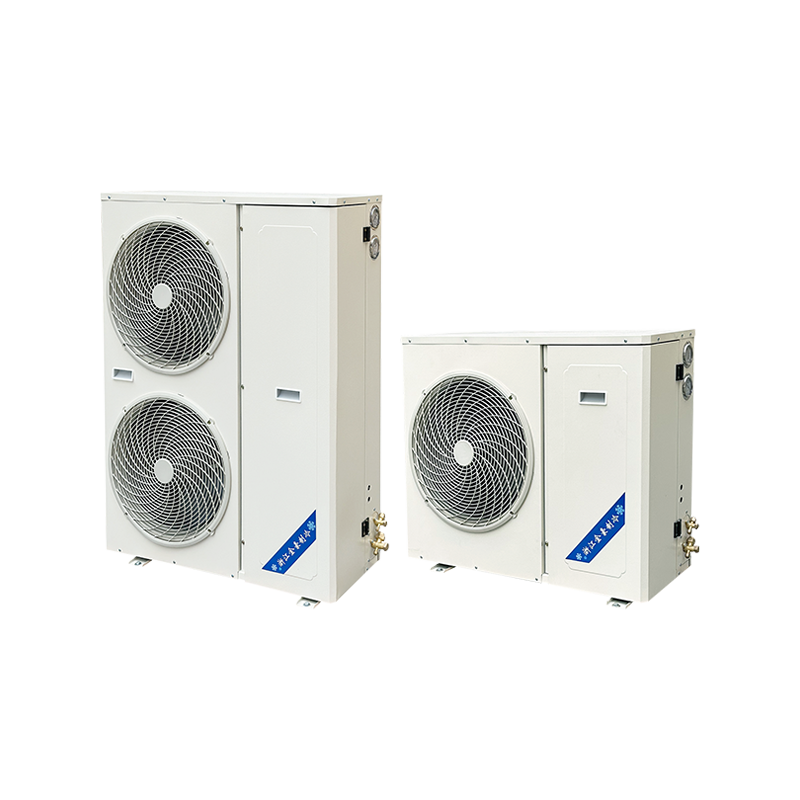
Key Components of an Air Cooled Condenser
Most air cooled condensers share the same core components, though construction details vary by manufacturer and application:
- Finned coil — typically copper tubing with aluminum fins, maximizing surface area for heat transfer while keeping weight and material cost manageable
- Fans — axial fans for lower static pressure applications, or centrifugal fans where the unit needs to push air through ductwork or overcome higher external resistance
- Casing and frame — weatherproof housing, since most air cooled condensers are installed outdoors and need to withstand rain, dust, and temperature extremes over years of service
- Refrigerant headers and connections — inlet and outlet piping sized to handle the system's refrigerant flow rate without excessive pressure drop
Air Cooled Condenser Capacity
Capacity is rated as the total heat rejection (TR, kW, or BTU/hr) a condenser can dissipate at a specified design temperature difference (TD) between the condensing refrigerant temperature and the entering air temperature — commonly rated at a 10°C or 15°C TD in manufacturer catalogs. Capacity isn't a fixed number independent of conditions: it scales with coil surface area, airflow volume, and the actual TD the unit operates at in the field, which is why the same physical condenser delivers more heat rejection on a cool day than on a hot one. Undersized capacity shows up as elevated condensing pressure and reduced system efficiency long before it causes outright failure, so capacity should be selected against the worst-case ambient design temperature for the installation site, not an average or typical condition.
Air Cooled Condenser Selection Guide
Selecting the right air cooled condenser involves matching several parameters simultaneously rather than optimizing for any single spec:
- Design heat rejection load — total system heat load, including compressor heat of compression, not just the evaporator's cooling capacity
- Design ambient temperature — the highest expected outdoor temperature at the installation site, since undersizing against a mild average temperature leaves no margin during summer peaks
- Refrigerant type and operating pressure — coil and header materials need to be rated for the specific refrigerant's pressure and chemical compatibility requirements
- Available installation space and airflow clearance — condensers need unobstructed air intake and discharge; installing units too close to walls or other equipment recirculates warm discharge air back into the intake and degrades performance
- Noise limits — fan selection and speed affect sound levels, which matters for units installed near occupied spaces or in noise-restricted zones
Air Cooled Condenser Applications
Air cooled condensers are used across nearly every application where mechanical refrigeration or air conditioning rejects heat to atmosphere without a water supply: commercial refrigeration for supermarkets and cold storage warehouses, rooftop and split-system air conditioning, industrial process cooling, food and beverage processing, and data center cooling systems. Their popularity in these settings comes down to lower installation complexity and operating cost compared to water cooled alternatives — no cooling tower, water treatment chemicals, or make-up water supply to manage — which makes them the standard choice everywhere except large-scale industrial and high-rise HVAC systems where water cooled equipment's higher efficiency at scale offsets its added complexity.
Air Cooled Condenser Efficiency
Efficiency in an air cooled condenser is driven primarily by coil surface area, airflow rate, and the temperature difference between refrigerant and ambient air — a larger coil with more airflow can reject the same heat load at a lower condensing temperature, which directly reduces compressor energy consumption across the whole refrigeration system. Because compressor power draw rises with condensing pressure, even a modest reduction in condensing temperature from a well-sized, well-maintained condenser can produce a meaningful reduction in total system energy use over a cooling season. Efficiency also degrades in the field from causes that have nothing to do with the original design: dirty coils that block airflow, fan motor wear, and poor site placement that allows discharge air recirculation back into the intake all quietly raise condensing temperature and energy consumption without necessarily triggering an alarm or failure.
Air Cooled vs Water Cooled Condensers
Air cooled condensers reject heat directly to ambient air, while water cooled condensers reject heat to a water loop that's then cooled by a separate cooling tower or other heat rejection device. Water cooled systems generally achieve better thermodynamic efficiency because water absorbs and transfers heat more effectively than air, allowing lower condensing temperatures and reduced compressor energy use — but that efficiency comes with the added cost, complexity, and maintenance of a water treatment program, cooling tower, and make-up water supply, along with legionella risk management. Air cooled systems trade some peak efficiency for dramatically simpler installation, lower maintenance overhead, and no water dependency, which is why they dominate in small to mid-size commercial and light industrial applications where the added efficiency of water cooling doesn't justify its operating complexity.
Air Cooled Condenser Maintenance
Because coil cleanliness and airflow are the biggest drivers of ongoing performance, most maintenance programs focus on keeping both in good condition:
- Clean coil fins regularly to remove dust, debris, and organic buildup that block airflow and raise condensing pressure
- Inspect fan motors and blades for wear, imbalance, or damage that reduce airflow volume
- Check refrigerant charge and system pressures periodically, since low charge or non-condensable gas in the system can mimic the symptoms of a dirty or undersized condenser
- Keep the area around the unit clear of vegetation, stored materials, or other obstructions that restrict intake and discharge airflow
- Verify electrical connections and fan motor amperage draw against nameplate values to catch developing motor issues before they cause a failure