


 English
 русский
Content
What an Air Cooler Evaporator Does
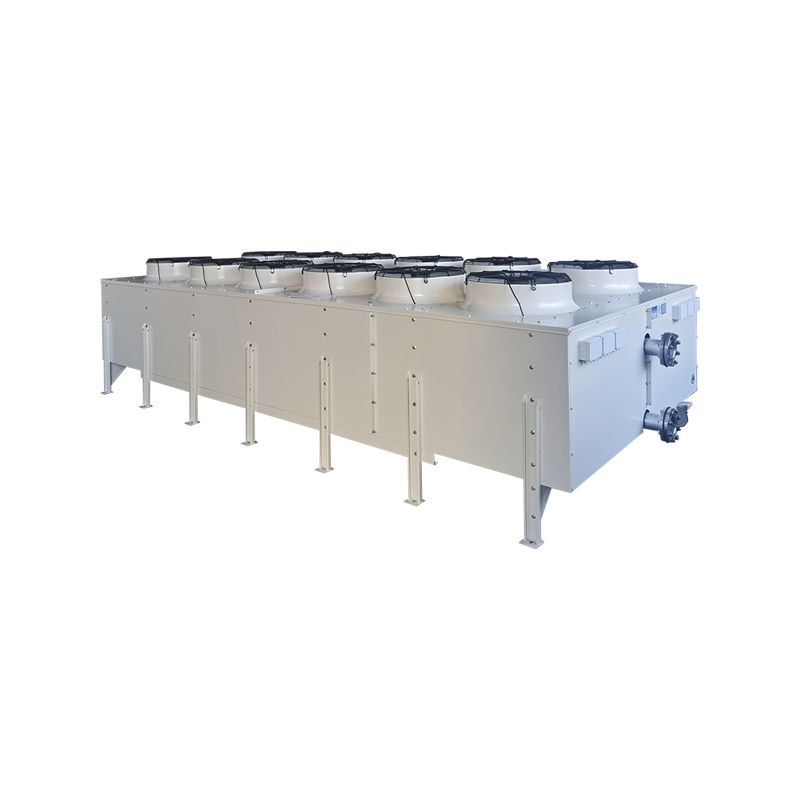
The evaporator is the heat-absorbing component at the core of any refrigeration-based air cooler. As refrigerant passes through its coil under low pressure, it changes phase from liquid to vapor and absorbs thermal energy from the surrounding air. That heat exchange drops the air temperature before the cooled air is distributed back into the space. In commercial refrigeration, the term "air cooler evaporator" typically refers to a unit cooler—a finned coil assembly with an integrated fan that forces air across the coil surface to maximize heat transfer.
Evaporator performance directly determines the temperature stability and energy efficiency of the entire refrigeration system. An undersized or fouled evaporator forces the compressor to run longer, raising energy costs and shortening equipment life. Correct selection and maintenance of the evaporator is therefore one of the most consequential decisions in cold chain and HVAC design.
Types of Air Cooler Evaporators
Evaporators are classified by refrigerant feed method, coil geometry, and application environment. The main categories used in air coolers are:
- Dry-expansion (DX) evaporators — Refrigerant enters the coil as a metered liquid through a thermostatic expansion valve (TXV) or electronic expansion valve (EEV) and exits fully vaporized. Used in most commercial unit coolers, split systems, and packaged air conditioners. Simple to control and widely compatible with modern refrigerants including R-410A, R-32, and R-454B.
- Flooded evaporators — The coil is kept filled with liquid refrigerant at all times, maximizing wetted surface area and heat transfer efficiency. Common in large industrial chillers and ammonia systems. Heat transfer coefficients 20–30% higher than DX coils, but require a liquid separator vessel and more complex controls.
- Direct-expansion fin-and-tube coils — The most common form in air cooler evaporators: copper or aluminum tubes mechanically expanded into aluminum fins. Fin spacing ranges from 4 mm (medium-temperature storage) to 12 mm (low-temperature freezer applications where frost accumulation must be managed).
- Microchannel (MCHX) evaporators — Flat aluminum multi-port tubes brazed with louvered fins. Refrigerant charge reduced by up to 50% vs. round-tube coils, with lower airside pressure drop. Increasingly used in rooftop units and high-efficiency residential equipment.
- Plate evaporators — Embossed stainless or aluminum plates welded or brazed together. Common in reach-in display cases and small blast chillers where space is limited and easy cleaning is important.
Key Performance Parameters
Selecting an air cooler evaporator requires matching several interdependent parameters to the application:
| Parameter | Typical Range | Impact |
|---|---|---|
| Cooling capacity (kW) | 0.5 kW – 200+ kW | Must match room heat load at design conditions |
| Temperature difference (TD) | 4°C – 12°C | Narrow TD → higher RH in storage; wide TD → drier product |
| Fin spacing (mm) | 4 mm – 12 mm | Wider fins resist frost blockage in low-temp applications |
| Airflow (m³/h) | 500 – 50,000 m³/h | Governs temperature uniformity and defrost frequency |
| Evaporating temperature (°C) | −40°C – +10°C | Determines refrigerant selection and compressor sizing |
| Defrost method | Electric, hot gas, air | Affects energy use, coil duty cycle, and product safety |
Temperature difference (TD) is a frequently misunderstood parameter. It is defined as the difference between the room air temperature and the refrigerant's saturated evaporating temperature. A TD of 5–6°C is standard for fresh produce storage where maintaining high relative humidity (90–95% RH) is critical. A TD of 10–12°C suits blast chilling and freezer tunnels where moisture retention is less important than pull-down speed.
Defrost Methods and Their Trade-offs
In any below-freezing application, moisture from the air condenses and freezes on the evaporator fins. Frost accumulation increases airside pressure drop, reduces airflow, and degrades heat transfer—ultimately raising the evaporating pressure and coil surface temperature. Defrost cycles must remove accumulated frost before it meaningfully impacts capacity.
- Electric defrost: Resistive heaters embedded in or below the coil melt frost directly. Simple and reliable; common in small freezer rooms and display cases. Energy penalty: each electric defrost cycle consumes energy that must subsequently be re-removed by the refrigeration system, roughly doubling the energy cost of the defrost event.
- Hot gas defrost: Compressed refrigerant vapor is redirected through the evaporator coil, transferring condenser-side heat to melt frost. Faster than electric defrost (5–10 minutes vs. 20–30 minutes) and adds no net energy since waste heat from the compressor is reused. Requires more complex piping and controls. Standard for large cold stores and supermarket centralized systems.
- Air defrost (off-cycle): The refrigeration system shuts off and fans continue running, allowing room-temperature air to melt light frost accumulation. Only viable where room temperatures are above 0°C (medium-temperature applications). No additional energy input required; slowest method.
- Water defrost: Water is sprayed over the coil to melt frost rapidly. Used in large blast freezers and commercial fish processing facilities. Effective but requires drainage systems and water supply.
Coil Materials and Refrigerant Compatibility
Standard air cooler evaporators use copper tubes with aluminum fins—a combination that balances thermal conductivity, formability, and cost. In coastal or chemically aggressive environments, copper can be replaced with stainless steel or aluminum alloy tubing, or fins can receive an epoxy or blygold coating to resist corrosion.
For ammonia (R-717) systems, copper is incompatible—ammonia reacts with copper to form copper nitride, which degrades both the metal and the refrigerant. Ammonia unit coolers use all-aluminum or all-steel construction throughout the coil, headers, and connections.
The industry transition to lower-GWP refrigerants is also affecting coil design. R-454B, R-32, and R-290 (propane) operate at different pressures and have different oil miscibility characteristics compared to legacy R-22 or R-404A. Coil wall thickness, brazed joint specifications, and oil return circuit design may all need adjustment when retrofitting existing evaporators to new refrigerants.
Installation and Maintenance Considerations
Correct evaporator placement determines both cooling uniformity and defrost drainage efficiency. Unit coolers should be positioned to deliver air across the entire room volume without short-circuiting back to the inlet. Common guidelines include:
- Mount the evaporator high on the wall or ceiling to exploit cold-air stratification downward
- Maintain at least 300 mm clearance between the fan discharge and any obstruction
- Slope the drain pan a minimum of 1:50 toward the drain outlet to prevent standing water from refreezing
- Install an insulated drain pipe with a heat trace or P-trap filled with propylene glycol in freezer applications
Preventive maintenance should include monthly fin inspection for frost bridging or dirt accumulation, annual coil cleaning with approved coil cleaner, fan motor bearing inspection, and refrigerant superheat checks at the evaporator outlet. A 3 mm frost buildup can reduce heat transfer by up to 10%; routine cleaning consistently returns systems to rated capacity without capital expenditure.
Frequently Asked Questions
- What is the difference between an air cooler evaporator and a condenser?
The evaporator absorbs heat from the cooled space as refrigerant evaporates inside the coil. The condenser rejects that heat to the outside environment as refrigerant condenses back to liquid. Both are heat exchangers, but they operate on opposite sides of the refrigeration cycle—the evaporator at low pressure and low temperature, the condenser at high pressure and high temperature.
- How do I size an air cooler evaporator for a cold room?
Start with a full heat load calculation covering wall transmission, infiltration, product load, internal heat sources (people, lighting, forklifts), and safety factor (typically 10–15%). Convert the total heat load in watts or kW to a required evaporator capacity at the design TD. Select a unit cooler rated at or above that capacity from manufacturer performance data published at the same evaporating temperature and airflow conditions.
- Why is my air cooler evaporator icing up faster than normal?
Accelerated frost buildup usually points to one of four issues: door seals are failing and allowing warm, humid air to enter the space; the defrost cycle frequency or duration is insufficient; airflow across the coil is restricted by a dirty or damaged fan; or the expansion valve is overfeeding refrigerant, keeping the coil surface temperature below the frost point continuously. Systematic diagnosis starting with door seal inspection and superheat measurement will identify the root cause.
- Can an air cooler evaporator be used with multiple refrigerants?
It depends on the coil materials, pressure ratings, and the compatibility of internal lubricants with each refrigerant. Many evaporators designed for R-404A can operate with R-448A or R-449A (low-GWP drop-in alternatives) with expansion valve and controls adjustment, but cannot use ammonia or CO₂ without a full coil replacement. Always verify pressure ratings against the maximum allowable working pressure (MAWP) listed on the unit's data plate.
- What fan type is used in air cooler evaporators?
Most unit coolers use axial fans—propeller-style blades that move large volumes of air at low static pressure, ideal for recirculating air within an enclosed space. Larger industrial air coolers and duct-connected systems may use forward-curved centrifugal fans to overcome higher static resistance. EC (electronically commutated) motor fans are now standard in energy-efficient designs, offering variable speed control and 20–30% lower motor energy consumption compared to conventional PSC motors.