


 English
 русский
Content
How Evaporative Coolers Work
Evaporative coolers work by passing warm, dry air through a water-saturated pad or media. As the air moves through the wet surface, water molecules absorb heat from the air and evaporate — converting from liquid to vapor. This phase change consumes energy in the form of heat, which is drawn directly from the passing airstream, lowering its temperature. The cooled, humidified air is then delivered into the space.
The process is identical in principle to the natural cooling sensation of wind on wet skin. The key variable governing effectiveness is the wet-bulb depression — the difference between ambient dry-bulb temperature and wet-bulb temperature. In hot, dry climates where relative humidity is below 30–40%, this gap is large and evaporative cooling can reduce air temperature by 10–20°C. In humid climates where the air is already close to saturation, the gap is small, evaporation slows, and temperature reduction is modest — the fundamental physical limitation of the technology.
A standard direct evaporative cooler consists of four core components: a fan that draws outside air through the unit, a water distribution system (pump and distribution manifold) that keeps the cooling media saturated, the evaporative media or pad itself, and a housing with louvered outlets to direct airflow. Some units add a float valve connected to a water supply line for continuous operation; others use a reservoir that requires manual refilling.
Unlike refrigeration-cycle air conditioners, evaporative coolers require the space to be partially open to function correctly. As the unit introduces cooled, humidified air, stale indoor air must have an exit path — typically an open window or door — to prevent the space from becoming saturated and the cooling effect from diminishing. Ventilation design is therefore part of effective evaporative cooler installation.
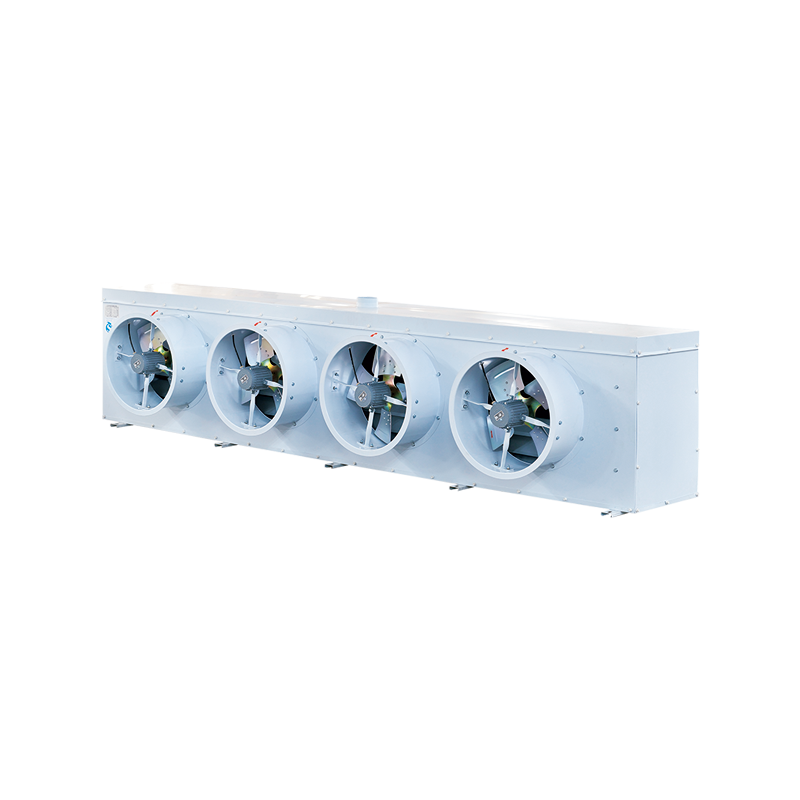
The Evaporator Pad: Core of the Cooling System
The evaporative media — commonly called the evaporator pad or cooling pad — is the component where the temperature drop actually occurs. Its surface area, water retention, and airflow resistance determine both the cooling efficiency and the energy consumption of the unit.
Three pad types dominate the market:
- Aspen (excelsior) pads — The traditional option, made from shredded aspen wood fiber bound in a mesh frame. Inexpensive and effective, with good water retention and natural resistance to bacterial growth from aspen's inherent tannins. Cooling efficiency is moderate; pads typically need replacement each season as the fiber degrades.
- Rigid cellulose (honeycomb) media — A structured corrugated cellulose pad with a honeycomb cross-section, typically 100–200mm thick. The geometric structure creates significantly higher surface area per unit volume than aspen pads, increasing evaporation rate and cooling efficiency by 15–25%. Rigid media also offers lower airflow resistance, reducing fan energy consumption. Lifespan is 3–5 years with proper maintenance.
- Synthetic polymer pads — Used in premium and commercial units, synthetic media (typically cross-linked polyester or polypropylene) resists mineral scale buildup better than cellulose in hard-water regions and can be cleaned and reused indefinitely. Higher upfront cost but lower lifetime replacement expense.
Pad maintenance — flushing mineral deposits, cleaning algae, and replacing degraded media — is the primary ongoing maintenance task for evaporative coolers. Neglected pads restrict airflow, harbor odor-causing bacteria, and reduce cooling efficiency significantly.
Air Conditioner vs. Evaporative Cooler: A Direct Comparison
Evaporative coolers and refrigerant-cycle air conditioners both reduce indoor temperature, but they operate on entirely different principles and suit very different conditions. Understanding the trade-offs is essential for choosing the right solution.
A refrigerant air conditioner moves heat out of the indoor space using a closed refrigerant circuit — compressor, condenser, expansion valve, and evaporator coil. It cools by extracting heat, not by evaporating water, and its performance is largely independent of outdoor humidity. It also dehumidifies as a side effect of cooling, making it effective in tropical and humid climates. The compressor and refrigerant circuit are mechanically complex, consume significant electricity, and require professional installation and periodic refrigerant servicing.
An evaporative cooler has no compressor, no refrigerant, and no condenser. It is mechanically simple — a fan, a pump, and a pad. Energy consumption is 75–80% lower than a comparable refrigerant air conditioner for the same cooling area, because only a fan motor and small pump are running rather than a compressor. Installation is simpler, purchase cost is lower, and maintenance is accessible to end users. The trade-off is strict climate dependence: effectiveness drops sharply above 50–60% relative humidity.
| Factor | Evaporative Cooler | Refrigerant Air Conditioner |
|---|---|---|
| Cooling mechanism | Water evaporation | Refrigerant heat exchange |
| Energy consumption | Low (fan + pump only) | High (compressor-driven) |
| Climate suitability | Hot, dry (RH <50%) | All climates including humid |
| Effect on humidity | Adds moisture | Removes moisture (dehumidifies) |
| Fresh air ventilation | Continuous fresh air intake | Recirculates indoor air |
| Installation complexity | Simple — portable or rooftop mount | Requires professional installation |
| Purchase cost | Lower | Higher |
| Maintenance | Pad cleaning/replacement, water system | Filter cleaning, refrigerant servicing |
One often-overlooked advantage of evaporative coolers is air quality. Because they draw in and exhaust outdoor air continuously, they do not recirculate stale indoor air the way a sealed-room air conditioner does. In workshops, commercial kitchens, and spaces with odors or airborne particulates, this continuous fresh-air supply is a functional benefit beyond temperature reduction.
Noise Levels in Evaporative Coolers
Evaporative coolers are inherently quieter than refrigerant air conditioners at equivalent cooling output, because they have no compressor — the dominant noise source in refrigerant systems. Noise in an evaporative cooler comes from two sources: the fan motor and blade assembly, and the water distribution system (pump and water trickling over the pad).
For bedroom and home office applications where low noise is a priority, the relevant specifications to compare are:
- Fan motor type — DC brushless motors run significantly quieter and more efficiently than AC induction motors. Premium quiet evaporative coolers use DC motors with variable speed control, allowing low-speed operation (typically 35–45 dB at 1 meter) that is comparable to a white noise machine.
- Fan blade design — Larger-diameter, slower-turning fans move the same air volume at lower RPM than small, fast fans, generating less turbulence noise. Centrifugal (squirrel cage) blower designs tend to be quieter than axial propeller fans at equivalent airflow.
- Pump noise and water flow — Submersible pumps in a well-designed water reservoir produce minimal noise. Cheap units with noisy pumps or poorly designed water distribution can produce gurgling or splashing sounds that are disproportionately irritating in quiet environments. Look for units with enclosed pump housings and overflow-controlled distribution manifolds.
- Sleep or night mode — Many current evaporative coolers include a dedicated low-speed mode with reduced fan RPM and dimmed display lighting, designed specifically for overnight use. Units with this feature typically operate at 38–48 dB in sleep mode — quieter than most air conditioners at any setting.
For comparison, a typical window air conditioner operates at 50–60 dB; a portable refrigerant AC at 52–58 dB. A well-designed evaporative cooler on its lowest setting can operate below 40 dB — a meaningful difference for light sleepers or open-plan office environments.
Choosing the Right Evaporative Cooler
Selecting an evaporative cooler requires matching unit capacity to the space and confirming the local climate is suitable. The primary sizing metric is airflow in CFM (cubic feet per minute) or m³/h, calculated from the room volume and the desired air changes per hour. A standard recommendation for residential cooling is 20–40 air changes per hour; for a 30 m² room with 2.7m ceilings (81 m³), this implies a required airflow of 1,600–3,200 m³/h.
Beyond capacity, the key selection criteria are:
- Water tank capacity and auto-fill — Larger tanks reduce refill frequency. Units with a garden-hose connection for continuous fill are better suited to whole-day or commercial use.
- Portability vs. fixed installation — Portable units on castors are flexible but limited in airflow capacity. Fixed rooftop or window-mount units can serve entire homes or commercial spaces but require ducting design.
- Cooling media type — Rigid honeycomb cellulose media delivers better efficiency than aspen pads and justifies the modest price premium for any unit intended for daily use.
- Local water hardness — Hard water causes scale buildup on pads and the water distribution system. In high-hardness regions, synthetic media and a regular descaling protocol extend service life considerably.