


 English
 русский
Content
- 1 Size the Condensing Unit Against Peak Load, Not Room Volume
- 2 Match the Condensing Unit Type to Your Refrigeration System Requirements
- 3 Refrigerant Choice and Evaporating Temperature Set the Compressor Stage
- 4 Ambient Conditions That Quietly Remove Condensing Unit Capacity
- 5 Five Checks Before You Release the Purchase Order
- 6 Condensing Unit Selection: Common Questions
Size the Condensing Unit Against Peak Load, Not Room Volume
A condensing unit is correctly sized when its rated cooling capacity at the site design condensing temperature still covers the room peak load with a 10 to 15 percent margin. Every other decision, compressor type, condenser style, refrigerant and controls, follows from that single comparison.
Room volume is only a starting point for load estimation, and it hides the three variables that actually break selections. The first is pull-down load. A holding room that needs 12 kW to maintain minus 18 C may need 30 kW to pull a warm product load down within the first 24 hours, and a blast freezer sits closer to a 2.5 to 3 multiplier on its holding load. The second is evaporating temperature. The same compressor frame running at minus 10 C evaporating delivers roughly 40 percent more capacity than it does at minus 30 C. The third is run time: a room cycling eight hours a day and a room running 20 hours a day need different margins and different part-load behaviour.
This is why a specification that says only low temperature is dangerous. It leaves the supplier free to quote a package that meets the number at minus 20 C evaporating temperature and misses it at minus 30 C, and the shortfall only appears when the first warm delivery arrives.
Match the Condensing Unit Type to Your Refrigeration System Requirements
Match the package to capacity, refrigerant and service access: box-type condensing units for small rooms up to roughly 15 kW, semi-hermetic units for cold storage from 5 to 60 kW, screw-type units above about 100 kW, and water-cooled units wherever plant space or ambient heat is the binding constraint. Capacity bands overlap, and the deciding factor is usually part-load behaviour rather than nameplate output.
| Unit type | Typical capacity | Best-fit systems | Watch-out |
| Box-type condensing unit | 0.5 to 15 kW | Small cold rooms, display cases, 0 to 8 C holding | Restricted housing airflow in tight plant rooms |
| Semi-hermetic condensing unit | 5 to 60 kW | Cold storage at minus 10 to minus 30 C, serviceable rooms | Oil return on suction runs longer than 25 m |
| Screw-type condensing unit | 100 kW and above | Blast freezers, process cooling, distribution cold stores | Part-load efficiency when the load profile varies widely |
| Water-cooled condensing unit | 5 to 500 kW | Basement plant rooms, hot climates, heat recovery | Water treatment and cooling tower maintenance |
| Industrial condensing unit | Project specific | Multi-evaporator systems, food processing lines | Engineering hours and coordination cost |
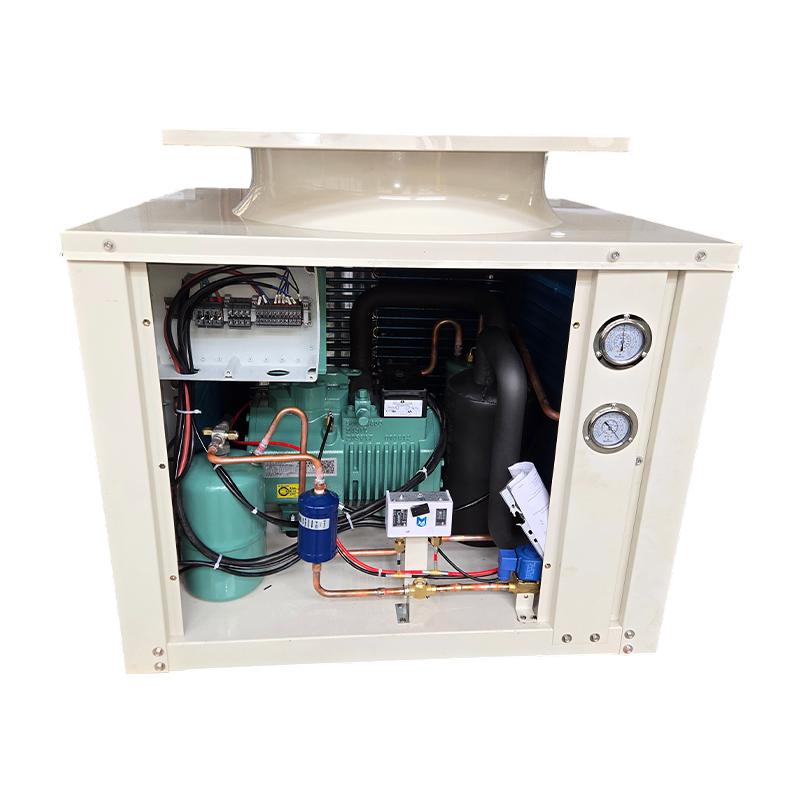 Box-Type Condensing Unit for Small-to-Medium CoolingA compact box-type package with customizable compressors and U-type condenser, suited to small rooms where maintenance access and part-load efficiency matter.View Product →
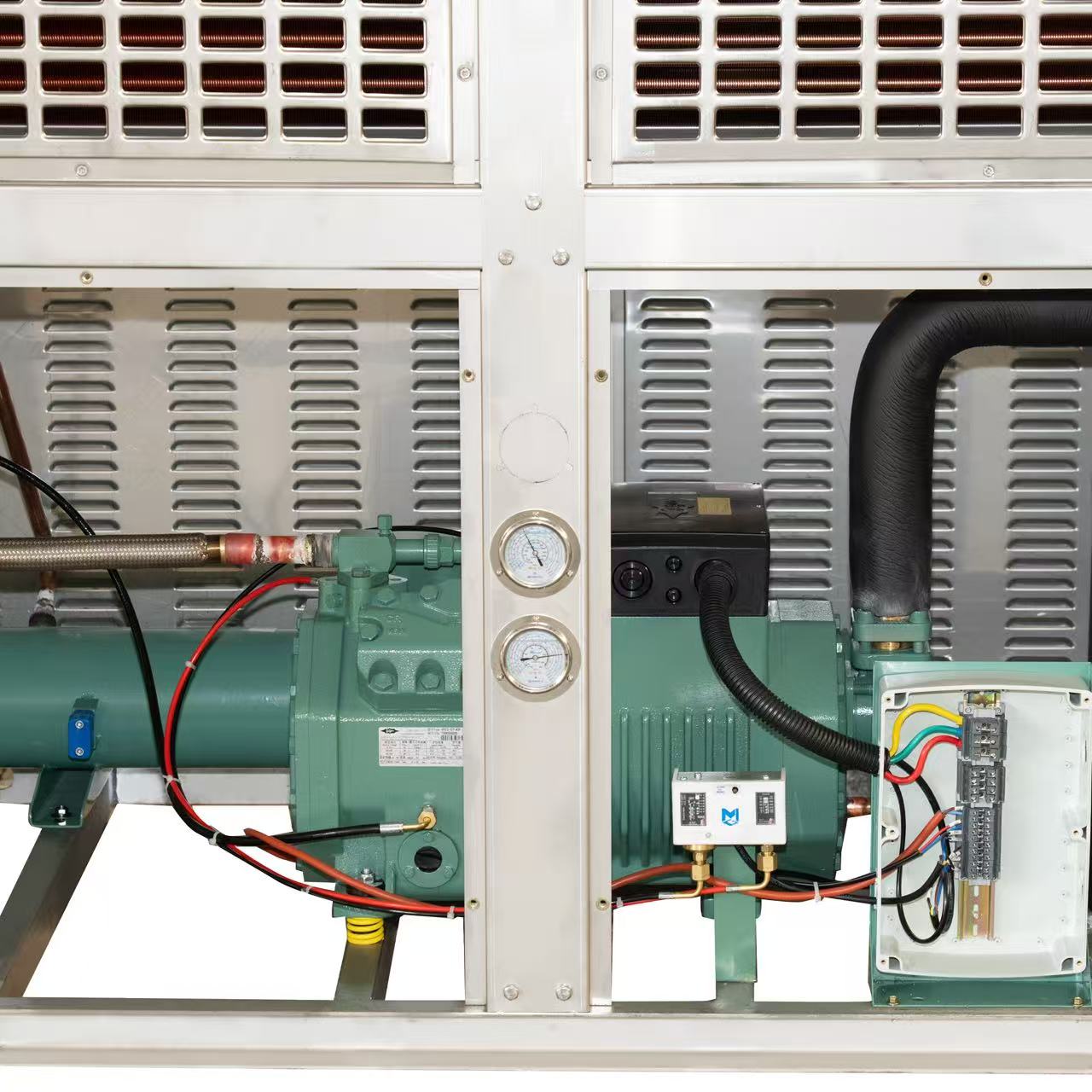 Industrial Condensing Unit for Cold Rooms and Process CoolingA standalone industrial package with scroll compressor, V-type heat exchanger and low-noise fan, worth comparing for cold-room and process-cooling duties.View Product →
 Water-Cooled Condensing Unit with Customizable ConfigurationA configurable water-cooled package with oil separator, pressure controls, solenoid valve and gauges, relevant where plant space or ambient heat constrains cooling.View Product →
Zhejiang Jinhao Refrigeration Equipment Co. Ltd. builds box-type, industrial, screw-type, semi-hermetic and water-cooled packages from a single catalogue family, which makes the comparison in the table practical rather than theoretical: the same manufacturer can quote two adjacent options and explain where each one loses. Reviews of condensing unit technology and market expansion point to the same conclusion, that the gap between adjacent package types is now driven by efficiency at partial load and by refrigerant compliance, not by headline kilowatts.
When two options both pass the capacity test
Choose the package with the lower condensing temperature at design ambient and the easier service access to the compressor and receiver. A semi-hermetic unit that can be opened for valve work in fifteen minutes beats a welded hermetic package that saves 4 percent on purchase price and costs two days of downtime later.
Refrigerant Choice and Evaporating Temperature Set the Compressor Stage
Single-stage packages cover evaporating temperatures down to about minus 25 C with R448A or R449A, and to roughly minus 30 C with an economizer. Below that point, two-stage or booster systems with a dedicated low-stage compressor usually cost less per kilowatt of refrigeration, because pressure ratios above about 10 to 1 push discharge temperature and oil life to their limits.
Refrigerant regulation now shapes the shortlist before thermodynamics does. R404A carries a global warming potential of 3,922 and R507A about 3,985, while R448A and R449A sit near 1,390 and R454C near 148. Where F-gas quotas apply, quoting R404A for a new cold store is a cost decision the owner pays again at every service visit, because reclaimed and virgin R404A keep separating in price.
Receiver volume and oil management belong in the unit selection, not in the accessory list. A package feeding a long suction line needs a suction accumulator and a correctly sized oil separator, and units running below minus 25 C fail at the compressor when oil return is under-designed, not at the evaporator.
Ambient Conditions That Quietly Remove Condensing Unit Capacity
Air-cooled condensing units lose roughly 1.5 to 2 percent of rated capacity for every 1 C the ambient rises above the rating point, so a package selected at 32 C runs short on a 42 C afternoon. The loss is predictable, which means it can be priced in at the quotation stage instead of discovered in August.
Three site factors compound the loss: condenser fouling in dusty or coastal air, air recirculation when units sit too close together on a roof, and altitude above roughly 1,000 m, where lower air density reduces mass flow across the coil. Any of them can turn a 15 percent margin into a deficit within two seasons.
- No water supply, tower or treatment cost
- Capacity falls with rising dry-bulb temperature
- Needs clear airflow and regular coil cleaning
- Fastest to install on retrofit and container sites
- Condensing temperature set by tower approach, 4 to 6 C above wet-bulb
- Stable capacity in hot climates and tight plant rooms
- Water treatment programme is mandatory, not optional
- Heat recovery to domestic hot water is practical
Five Checks Before You Release the Purchase Order
Run these five checks on every quotation and most selection errors disappear before the equipment ships.
- Recalculate capacity at the real design ambient temperature, not at the catalogue rating point, and ask the supplier to state the ambient their figure assumes.
- Confirm both evaporating and condensing temperatures behind the published kilowatts, plus the refrigerant the rating is based on.
- Verify electrical supply, 380 to 400 V three-phase or otherwise, and the starting current the site can actually deliver.
- Inspect service access to compressor, receiver and controls, and confirm spare parts lead time for valves and filter driers.
- Check the control package supports the defrost strategy and alarm integration the room needs, and that documentation includes wiring and piping diagrams.
Selection decisions made on paper are only as good as the site survey behind them. Detailed guidance on industrial refrigeration equipment design and selection is worth reading alongside the quotation, because it covers the piping and load assumptions that sit outside the condensing unit datasheet.
Condensing Unit Selection: Common Questions
What size condensing unit do I need for a 100 cubic metre cold room?
A 100 cubic metre room held at 0 to 5 C typically needs 6 to 9 kW of cooling at a 35 C design ambient, while the same volume held at minus 18 C typically needs 10 to 14 kW. Insulation thickness, door traffic and product entry temperature move those figures by 30 percent or more, so calculate the load rather than scaling from volume alone.
Is a water-cooled condensing unit better than an air-cooled one?
Water-cooled is better only when plant space is tight, ambient temperatures are high, or water and treatment costs are low. Its capacity stays stable because condensing temperature follows the wet-bulb approach, but the tower, pumps and water treatment add maintenance that an air-cooled package does not require.
Can one condensing unit serve several evaporators?
Yes, provided the receiver, oil management and controls are sized for the combined load and the evaporators run at similar evaporating temperatures. Mixing a 5 C chiller evaporator with a minus 25 C freezer coil on one compressor usually fails on oil return and on refrigerant distribution.
What evaporating temperature should I specify?
Specify an evaporating temperature 6 to 10 K below the room temperature you must hold, so a minus 18 C freezer is quoted at minus 24 to minus 28 C evaporating. A narrower temperature difference needs a larger evaporator, and a wider one dries out the product and wastes compressor capacity.