


 English
 русский
At 100 m2 and 5 m racking, a cold room may have only 600 mm of free headspace above the top beam. That gap decides whether the evaporator hangs from the ceiling or takes floor positions. Air cooler evaporator selection starts with usable height, traffic, cleaning, and service access, not a catalog capacity rating.
Ceiling mounting protects storage area. Floor mounting is easier to reach and suits low rooms. Neither style is universally better; the room layout and maintenance model decide.
Content
- 1 Air Cooler Evaporator Selection Starts With the Room
- 2 Ceiling-Mounted Air Cooler Evaporator: Best Fit and Constraints
- 3 Floor-Mounted Air Cooler Evaporator: Where It Solves More Problems
- 4 Compare Airflow, Defrost, and Service Access Before You Buy
- 5 Match Defrost Method and Temperature Class to the Application
- 6 Installation, Lifecycle Cost, and the Final Selection Framework
- 7 FAQ: Ceiling-Mounted vs Floor-Mounted Air Cooler Evaporators
Air Cooler Evaporator Selection Starts With the Room
Conclusion: fix the room geometry and operating pattern first, then compare evaporator models. A unit that fits the duty but blocks a door, short-circuits air, or cannot be serviced safely is the wrong unit.
Measure from the top of the highest racking to the roof structure. A ceiling unit needs a clear air path above the casing, room for the fan guard, and enough throw to reach the far wall without blasting a loading door. A floor unit needs a protected footprint, a service aisle, and a position clear of pallet trucks.
| Selection factor | Ceiling-mounted | Floor-mounted |
| Floor area used | 2-4 m2 per 100 m2 | 8-12 m2 per 100 m2 |
| Height demand | Free space above casing | Works under a low roof |
| Air path | Long throw over racking | Low-level circulation |
| Service access | Lift or scaffold for major work | Direct access from aisle |
| Drain route | Long runs need freeze protection | Short runs with simple slope |
| Best fit | High-bay, dense racking | Low-bay, wide aisles |
These values are early planning ranges, not code limits. Confirm fan clearance, anchors, and drain slope against the selected model and local requirements.
Ceiling-Mounted Air Cooler Evaporator: Best Fit and Constraints
Conclusion: choose ceiling mounting when storage density and clear floor movement matter more than easy overhead access. The ceiling is often the only unused surface in a high-bay cold store.
Hanging the unit frees pallet positions and keeps the evaporator out of forklift traffic. The trade-off is installation and service. The roof or ceiling structure must carry the unit, fan vibration, and defrost water lines; the drain must slope continuously to a protected outlet. In freezer rooms, a long drain run can refreeze and turn a minor service call into a shutdown.
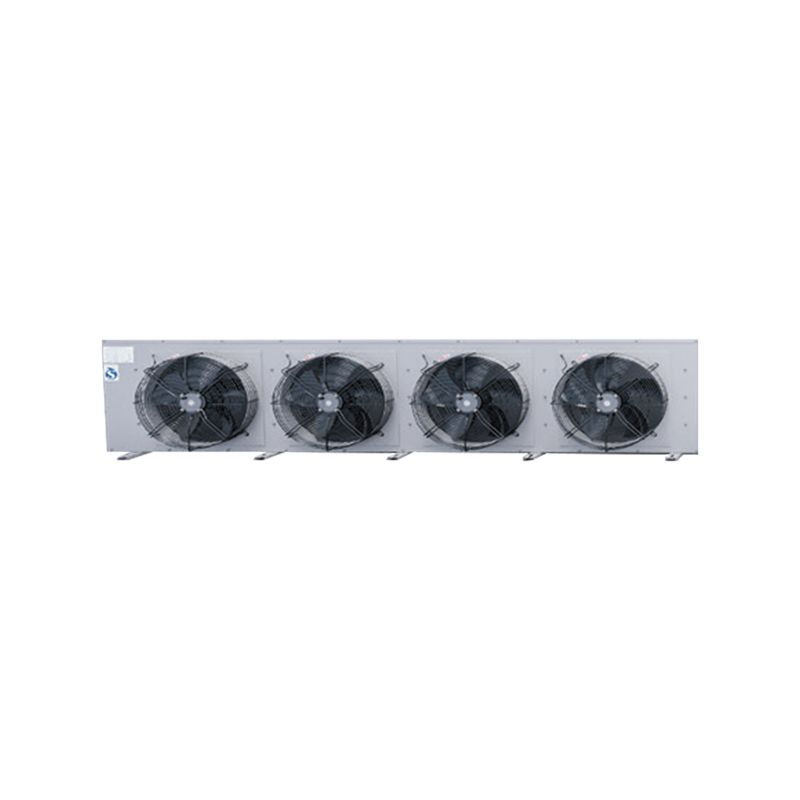 G Series Ceiling-Mounted Electric-Defrost Air CoolersCeiling-mounted evaporators with slanted drain trays, wind deflectors, and multiple fin spacings for reviewing installation, drain routing, and airflow layout in cold rooms.View Product →
Long air throw is useful only when the racking layout lets the jet reach the far wall and return without short-circuiting. A 12 m throw aimed into a pallet face delivers less useful cooling than a shorter, better-directed pattern.
Jinhao's ceiling range includes D-type, DD medium-temperature, DJ, DL high-temperature, dual-discharge, water-defrost, and G-series efficient ceiling-mounted air coolers. Match temperature class and defrost method to the room before comparing fan power or coil surface.
Floor-Mounted Air Cooler Evaporator: Where It Solves More Problems
Conclusion: floor mounting is the stronger choice in low-ceiling rooms, washdown areas, and sites where maintenance cannot depend on lifts. It trades floor area for direct service and short refrigerant and drain runs.
A floor unit is easier to inspect, clean, and repair, but it must be protected from pallet trucks and placed so the service aisle does not vanish when the room is full. Use a curb or base, isolate vibration, and keep the fan discharge away from doors and floor-level product. In a 100 m2 room, an 8-12 m2 equipment and aisle zone can remove a full row of pallet positions.
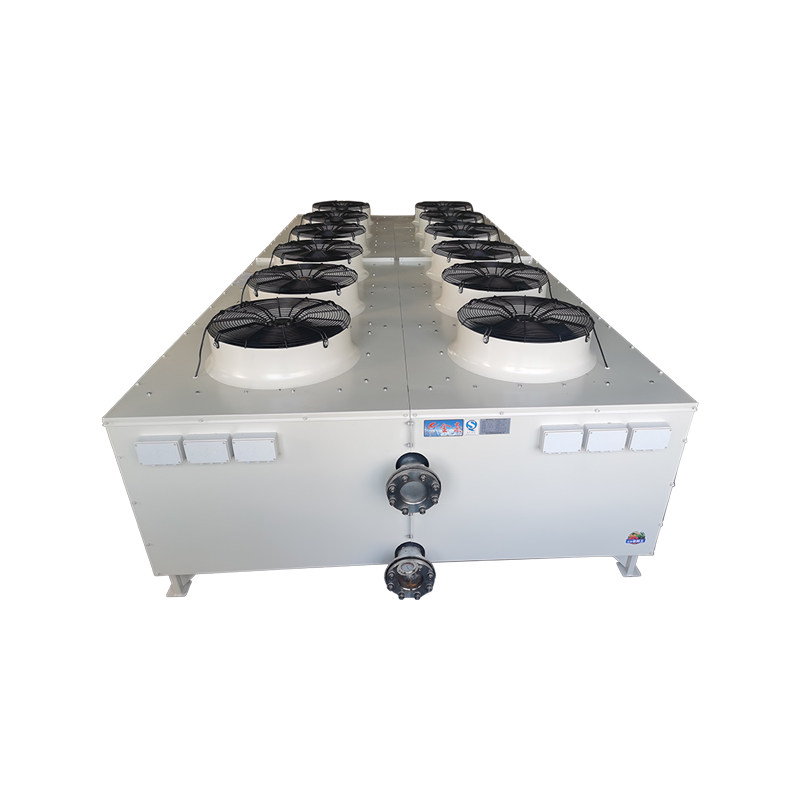 Floor-Standing Air Coolers for Refrigeration RoomsFloor-installed evaporators in high-, medium-, and low-temperature series, suited to layouts where service access matters more than maximizing pallet positions.View Product →
Best fit for low rooms
Floor-standing evaporators suit rooms with limited headroom and layouts where direct service access is more valuable than the last few square meters of storage.
Jinhao's floorstanding air coolers use the same temperature and defrost logic as ceiling units. Check floor bearing capacity, coil cleaning clearance, and drain route before finalizing the position.
Compare Airflow, Defrost, and Service Access Before You Buy
Conclusion: compare the installation as a system, not just the evaporator's nominal capacity. Airflow path, frost pattern, defrost water, and service clearance decide whether the unit behaves as specified after the room is full.
Ceiling units usually rely on longer throws and dual-discharge patterns to cover racking; floor units move air at low level, where pallets and staff can block the path. Fin spacing also matters: freezers typically need wider gaps and more robust defrost than chill rooms. A unit with the right capacity but the wrong fin spacing can ice over quickly.
Planning ranges for early layout. Actual footprint depends on unit size, fan clearance, and local access rules.
Service test: ask how a fan motor, defrost heater, or drain pan will be reached without moving product. If the answer needs a scissor lift, add that cost and downtime to the ceiling option.
Match Defrost Method and Temperature Class to the Application
Conclusion: set the temperature class and defrost method before choosing the mounting style. A ceiling-mounted freezer unit with a long, poorly sloped drain is a worse decision than a floor unit with a short drain and direct access.
Jinhao's catalog separates DL high-temperature, DD medium-temperature, and DJ low-temperature air coolers, and also lists water-defrost models. Frost behavior changes with room temperature, door traffic, product load, and defrost frequency. Electric defrost is common in freezer rooms; water defrost suits certain medium-temperature duties; air defrost fits only mild applications with low frost load.
Definition: air cooler evaporator
An air cooler evaporator is a finned-tube heat exchanger that absorbs heat from room air and rejects it to the refrigerant, while fans move air across the coil and distribute cooled air through the cold room.
Use this air cooler evaporator selection guide to check coil details, but keep the mounting decision tied to the room. Defrost water must leave the evaporator, drain, and room without pooling or refreezing.
Installation, Lifecycle Cost, and the Final Selection Framework
Conclusion: compare installed cost and maintenance access, not purchase price. The cheaper unit can become the more expensive choice once lifting, pipe runs, drain protection, and downtime are included.
Ceiling-mounted
- Needs roof or ceiling anchors and vibration isolation
- Longer refrigerant and drain runs are common
- Major service may require a lift or scaffold
- Preserves floor area for storage and traffic
Floor-mounted
- Needs a curb, floor protection, and a clear aisle
- Shorter pipe and drain runs are common
- Direct access speeds inspection and cleaning
- Consumes floor area and can be hit by trucks
- Map usable height and floor area. Mark racking, doors, pallet routes, and the service zone on the layout.
- Set the temperature class and defrost method. Confirm room temperature, product load, door traffic, and drain route.
- Compare air paths. Check throw, fan position, and obstruction at full storage, not on an empty plan.
- Price the maintenance access. Include lifts, aisles, isolation, and downtime for coil cleaning or fan repair.
Default choice: ceiling-mounted for high-bay, dense racking, and clear floor operations; floor-mounted for low headroom, direct service access, and layouts where the floor zone can be protected.
Zhejiang Jinhao Refrigeration Equipment Co. Ltd. manufactures both ceiling and floorstanding air cooler evaporators and related refrigeration components, so the final choice can be matched to temperature class, defrost method, and room layout rather than forced into one mounting style.
FAQ: Ceiling-Mounted vs Floor-Mounted Air Cooler Evaporators
Which mounting style is better for a low-ceiling cold room?
Floor mounting is usually the practical choice when a suspended unit would leave too little clearance above the casing or block the air path. Confirm that the floor unit can be protected from traffic and that the service aisle remains clear when the room is full.
Does a ceiling-mounted evaporator always save floor space?
It saves storage floor area, but it still needs a service zone, lifting access, and a drain route. In rooms with fragile roofs or long pipe runs, the installed cost can outweigh the floor-space benefit.
What is the first check in air cooler evaporator selection?
Measure usable height, racking clearance, door positions, and the maintenance route. Those four facts eliminate mounting styles faster than a capacity table.