


 English
 русский
Content
What a Refrigeration Air Cooled Condenser Actually Does
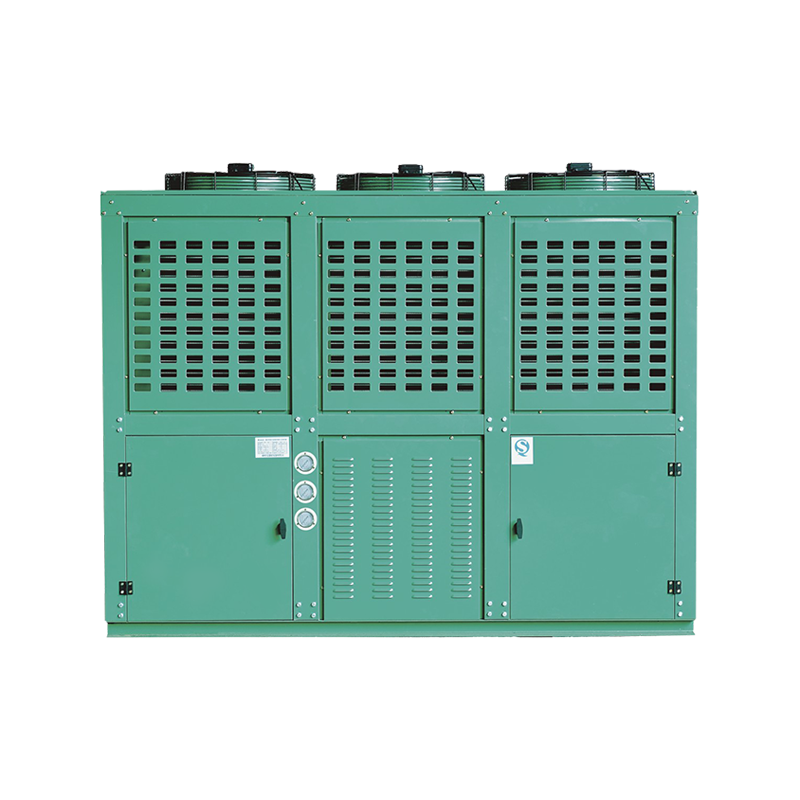
A refrigeration air cooled condenser is the component that rejects heat from the refrigerant back to the surrounding air, converting hot compressed refrigerant gas back into a liquid before it moves on to the expansion valve and evaporator. As ambient air is drawn or forced across the finned coil, it strips heat from the refrigerant flowing inside, causing the gas to condense. Many designs push the process slightly further with a subcooling stage, cooling the liquid refrigerant a few degrees below its condensation point to prevent vapor bubbles from forming in the liquid line, which improves overall system efficiency and stability.
The core components working together in this process are the finned coil (typically copper or aluminum tubing, arranged in serpentine or coil patterns to maximize surface area), the fan (axial or centrifugal, depending on airflow requirements), and fins that dramatically increase the surface area available for heat exchange without significantly increasing the unit's footprint.
Forced Draft vs. Induced Draft Configurations
Most refrigeration air cooled condensers are built in one of two fan arrangements, and the choice affects both performance and where the unit can be installed. In a forced draft configuration, the fan sits on the air inlet side and pushes air through the coil, which tends to produce a higher heat transfer rate and is often preferred in high-ambient-temperature applications. In an induced draft configuration, the fan is positioned on the discharge side and pulls air through the coil, which typically distributes airflow more evenly across the coil face and can reduce the risk of hot air recirculating back into the intake.
| Configuration | Fan Position | Typical Advantage |
|---|---|---|
| Forced draft | Air inlet side | Higher heat transfer, suited to high ambient heat |
| Induced draft | Air discharge side | More even airflow distribution across the coil |
Comparison of the two primary fan arrangements used in air cooled condenser design.
Sizing Starts With Total Heat of Rejection, Not Btuh Alone
Unlike evaporators, compressors, and metering devices, which are selected directly off the system's cooling capacity (Btuh), a refrigeration air cooled condenser has to be sized around the total heat of rejection (THR) — the combined heat energy absorbed by the evaporator plus the additional heat of compression added by the compressor. Skipping this step and sizing a condenser purely off the evaporator's rated capacity is a common source of undersized systems that struggle to maintain pressure during peak ambient conditions.
Once THR is established, the design temperature difference (TD) — the design condensing temperature minus the design ambient temperature — determines which condenser model on a manufacturer's selection chart actually fits the application. Installations at higher elevations require an additional correction factor applied to the THR figure, since thinner air at altitude reduces heat rejection capacity for a given airflow rate.
Why Ambient Temperature Has an Outsized Effect on Performance
A condenser's heat rejection capacity is directly tied to the temperature difference between the coil and the surrounding air. As ambient temperature climbs, that differential shrinks, and the condenser has to work harder — running at higher condensing pressure — to reject the same amount of heat. This is the reason systems that perform fine in spring or fall can struggle to hold temperature on the hottest days of summer, even with no mechanical fault present; the condenser simply has less thermal driving force to work with.
- Coil cleanliness directly affects airflow and heat transfer — dust and debris buildup on fins is one of the most common, and most preventable, causes of reduced capacity
- Variable-speed fans adjust rotation based on real-time cooling demand and ambient temperature, reducing energy use and noise during periods when full capacity isn't needed
- Adequate clearance around the unit prevents warm discharge air from recirculating back into the intake, which otherwise raises the effective ambient temperature the condenser sees
Matching Condenser Type to the Application Environment
Standard finned-coil condensers, using copper or aluminum tubing, cover most general refrigeration and air conditioning needs where space and cost are the primary drivers. For larger commercial and industrial systems, dual-fan condensers running fans in parallel increase total airflow and heat exchange capacity without requiring a proportionally larger single fan, which also helps manage noise levels in occupied spaces.
Environment plays a significant role in material selection as well. Marine-grade refrigeration air cooled condensers, built with stainless steel or epoxy-coated aluminum fins, are specified for ships, offshore platforms, and coastal installations, where salt exposure would otherwise corrode standard aluminum fins within a few seasons. In high-humidity environments, hydrophilic-coated fins help prevent water accumulation and frost buildup, which would otherwise restrict airflow and reduce capacity over time.