


 English
 русский
Content
- 1 What Is an Evaporative Cooler?
- 2 How Air Conditioners Work: The Key Difference
- 3 Swamp Cooler vs AC: Side-by-Side Comparison
- 4 The Humidity Threshold: Where Swamp Coolers Stop Working
- 5 Evaporative Air Cooler vs Portable AC: The Rental and No-Install Comparison
- 6 Operating Cost and Energy Efficiency Over a Season
- 7 Which System Is Right for Your Home?
What Is an Evaporative Cooler?
An evaporative cooler — commonly called a swamp cooler — is a device that cools air by passing it through water-saturated pads. As warm outside air moves through the wet media, water evaporates and absorbs heat from the air, dropping its temperature by 15°F to 40°F (8°C to 22°C) before the air enters the living space. The cooled air is then pushed into the room by a fan, and the warmer indoor air exits through open windows or vents. No refrigerant, no compressor, no condenser — the entire mechanism relies on the physics of evaporative heat transfer.
Evaporative coolers come in two main configurations. Whole-house or ducted units mount on the roof or an exterior wall and connect to ductwork — standard in homes across the American Southwest. Portable evaporative air coolers are standalone units with a water reservoir that sit on the floor and require no installation, making them popular for single-room use, workshops, and outdoor events. A third type, the two-stage or indirect-direct evaporative cooler, pre-cools air without adding moisture first, then passes it through a direct evaporative stage — achieving lower outlet temperatures with less humidity impact.
The technology is not new. Evaporative cooling has been used in Egypt and Persia for thousands of years, and the first mechanical swamp coolers appeared in the United States in the 1930s. Their simplicity is also their core limitation: they only work when the incoming air is dry enough to absorb more moisture.
How Air Conditioners Work: The Key Difference
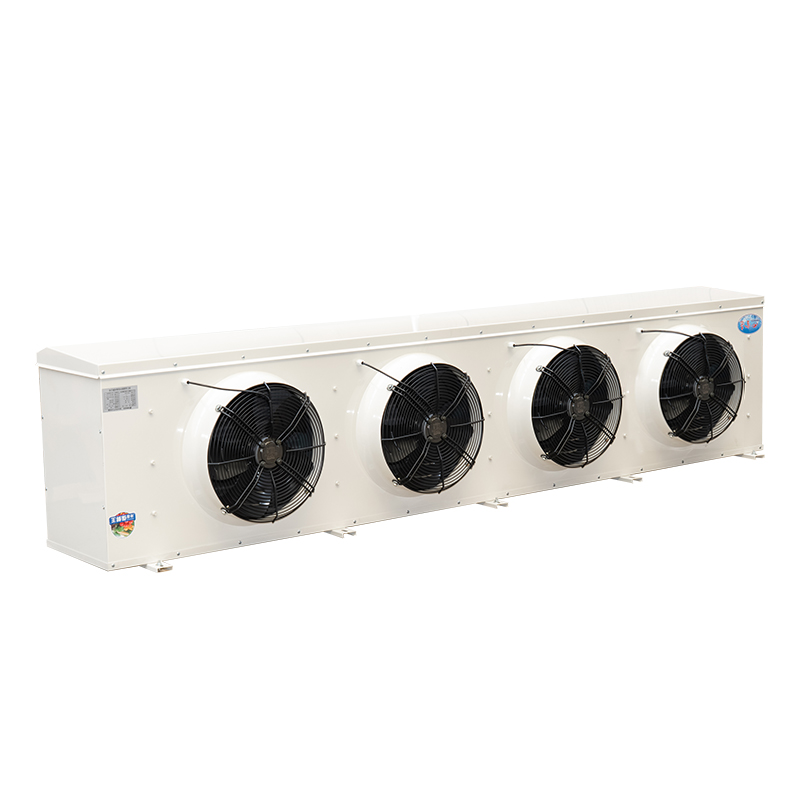
A conventional air conditioner operates on a refrigeration cycle entirely separate from outdoor humidity. A compressor pressurizes refrigerant gas, which then releases heat through an outdoor condenser coil. The refrigerant expands and cools as it moves to the indoor evaporator coil, where warm indoor air passes over it and gives up its heat. The cooled, dehumidified air returns to the room; the extracted heat is expelled outside. Crucially, the AC does not need or import outdoor air — it recirculates and cools the same indoor air in a closed loop.
This closed-loop design means an air conditioner actively removes moisture from indoor air as a byproduct of the cooling process. In humid climates, this dehumidification is as valuable as the temperature drop itself — high humidity at a given temperature feels far hotter than low humidity at the same temperature, a relationship captured by the heat index. An AC running at 75°F and 45% relative humidity delivers meaningfully more comfort than a swamp cooler running at the same temperature but 70% relative humidity.
Swamp Cooler vs AC: Side-by-Side Comparison
The right choice between a swamp cooler and an air conditioner depends on climate, installation constraints, operating budget, and environmental priorities. The table below covers the most decision-relevant dimensions.
| Factor | Swamp Cooler (Evaporative) | Central Air Conditioner | Portable AC |
|---|---|---|---|
| Cooling Mechanism | Evaporation of water | Refrigerant cycle | Refrigerant cycle |
| Energy Use | 75–300W (fan + pump) | 1,000–5,000W | 900–1,500W |
| Installation Cost | $300–$2,500 | $3,000–$12,000 | $300–$800 (no install) |
| Humidity Effect | Adds moisture | Removes moisture | Removes moisture |
| Works in High Humidity | No | Yes | Yes |
| Water Consumption | 3–15 gallons/day | None (condensate drains) | None |
| Refrigerant / Emissions | None | HFCs (R-410A, R-32) | HFCs |
| Best Climate | Arid (<30% RH) | Any climate | Any climate |
The Humidity Threshold: Where Swamp Coolers Stop Working
Evaporative cooling efficiency is directly governed by the wet-bulb depression — the difference between ambient dry-bulb temperature and wet-bulb temperature. The larger the gap, the more cooling capacity the unit has. At 30% relative humidity, a swamp cooler can drop incoming air temperature by 20–25°F. At 60% relative humidity, the same unit may only achieve a 5–8°F drop — barely perceptible in a hot room. Above 70% relative humidity, evaporative coolers provide no meaningful comfort benefit; the outgoing air is already too saturated to absorb much additional water vapor.
This makes climate the single most important factor in the swamp cooler vs AC decision. Evaporative coolers dominate in desert and semi-arid regions: Arizona, Nevada, New Mexico, inland California, Colorado's Front Range, and similar climates where summer humidity regularly stays below 30%. In the Gulf Coast, the Southeast, the Mid-Atlantic, and the Pacific Northwest during marine layer conditions, evaporative cooling is largely ineffective, and a refrigerant-based AC is the only practical solution.
Even in arid climates, the monsoon season complicates matters. In Phoenix and Tucson, for example, July and August bring the North American Monsoon — relative humidity spikes from 15% to 50–60% for weeks at a time. Homeowners who rely exclusively on swamp coolers during this period often find them inadequate precisely when temperatures are at their annual peak.
Evaporative Air Cooler vs Portable AC: The Rental and No-Install Comparison
For renters, apartment dwellers, or anyone who cannot install a central system, the comparison narrows to a portable evaporative air cooler versus a portable AC unit. Both plug into a standard outlet and require no permanent installation, but their real-world performance diverges sharply.
A portable evaporative air cooler costs $50–$300, draws 50–150W, is nearly silent, and adds humidity — beneficial in winter-dry climates where indoor air in summer is already parched. Its drawback is the same as any swamp cooler: it fails in humid conditions and requires frequent water refills (most reservoirs hold 5–15 liters and last 4–8 hours at maximum output). It also adds moisture to the room continuously, which can cause discomfort if the space is not ventilated.
A portable AC in the same price range ($300–$700) draws 900–1,400W, produces a consistent 8,000–14,000 BTU/hr of cooling regardless of outdoor humidity, and actively dehumidifies the room. Its practical limitation is exhaust: the hot condenser air must vent outside through a window kit hose. This single-hose design creates negative pressure in the room, drawing in warm outside air through gaps — reducing real-world efficiency by 20–30% compared to the rated BTU figure. Dual-hose portable ACs solve this by drawing intake air directly from outside, but are larger, louder, and more expensive. For a dry climate, a portable evaporative cooler at one-fifth the running cost is hard to beat. For anywhere with summer humidity above 50%, a portable AC is the only option that actually works.
Operating Cost and Energy Efficiency Over a Season
Energy cost is where evaporative coolers have their most compelling advantage. A whole-house swamp cooler running at 300W for 8 hours per day at $0.15/kWh costs roughly $0.36 per day. An equivalent central AC system running at 3,500W costs approximately $4.20 per day — nearly 12 times more. Over a four-month cooling season, that difference compounds to roughly $460 versus $40 in electricity costs, a saving that typically recoups the swamp cooler's lower purchase price within the first summer.
Maintenance costs also favor the evaporative cooler in the short term — pad replacement ($20–$60 per season), belt checks, and water line inspection are straightforward DIY tasks. However, hard water accelerates mineral scaling on the pads and pan, requiring more frequent cleaning and replacement in calcium-rich areas like Las Vegas or Phoenix. AC systems have higher maintenance costs (refrigerant checks, coil cleaning, filter replacement) and significantly higher repair costs when compressors or coils fail, with compressor replacements alone running $1,200–$2,500.
For households in genuinely arid climates running cooling loads for 120+ days per year, the lifetime cost advantage of an evaporative cooler over a central AC system can exceed $10,000 over a 10-year period when installation, operating, and maintenance costs are combined. In humid climates, that calculation is irrelevant — the swamp cooler simply cannot do the job, making the AC's higher cost the only viable option.
Which System Is Right for Your Home?
The decision framework is straightforward once climate data is factored in. Check your location's average July relative humidity — the peak cooling month in most of North America:
- Below 30% average RH — A whole-house evaporative cooler is the optimal primary system. Cost-effective, energy-efficient, and well-suited to the climate. Consider supplementing with a mini-split or window AC for monsoon periods if applicable.
- 30–50% average RH — A two-stage (indirect-direct) evaporative cooler can work effectively in this range, but a standard single-stage swamp cooler will struggle on humid days. A conventional AC is more reliable, but a high-efficiency evaporative system may still offer cost savings in marginal climates.
- Above 50% average RH — A refrigerant-based air conditioner is the correct choice. An evaporative cooler in this climate will add uncomfortable humidity without delivering adequate cooling, and energy savings will not materialize because the unit must run continuously at full output to achieve marginal results.
For renters or those needing room-by-room cooling without installation: in dry climates, a portable evaporative cooler is cost-effective and practical. In humid or mixed climates, a dual-hose portable AC delivers the most consistent results, despite the higher upfront cost and energy draw. Neither portable option replaces a properly sized whole-house system for sustained summer heat, but both are significantly better than no cooling at all.