


 English
 русский
Content
- 1 The Core Principle: How Evaporative Cooling Actually Works
- 2 What Is an Air Cooler Evaporator
- 3 What Is an Evaporative Air Cooler
- 4 Side-by-Side Comparison: Air Cooler Evaporator vs Evaporative Air Cooler
- 5 Performance Limitations and Climate Constraints
- 6 Maintenance Requirements for Long-Term Performance
- 7 How to Choose the Right System for Your Application
The Core Principle: How Evaporative Cooling Actually Works
Evaporative cooling is one of the oldest and most energy-efficient heat transfer mechanisms in engineering. When water evaporates, it absorbs latent heat from its surroundings — approximately 2,260 kJ per kilogram of water vaporized — which directly lowers the temperature of the air passing through the system. This principle underpins both the air cooler evaporator used in refrigeration and HVAC coil assemblies, and the standalone evaporative air cooler used in direct cooling applications.
While the two systems share a name and a thermodynamic foundation, they operate through different mechanisms, serve different applications, and have distinct performance boundaries. Selecting the wrong type leads to poor cooling efficiency, excessive energy consumption, or uncomfortable indoor conditions.
What Is an Air Cooler Evaporator
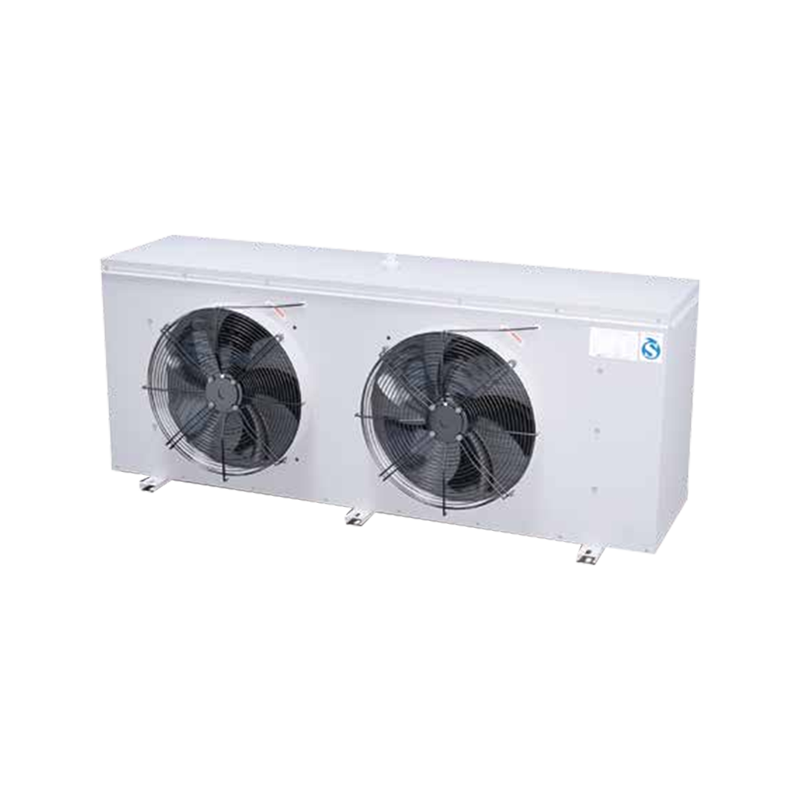
In refrigeration and vapor-compression HVAC systems, the air cooler evaporator is the heat exchanger coil where refrigerant absorbs heat from the surrounding air and evaporates from liquid to vapor. It is one of the four core components in a refrigeration cycle — alongside the compressor, condenser, and expansion valve.
As warm air passes over the evaporator coil, the low-pressure refrigerant inside (typically R-404A, R-448A, R-410A, or CO₂ in modern systems) absorbs that heat and changes phase. The cooled air is then circulated back into the conditioned space. This makes the air cooler evaporator the primary heat-absorption component in:
- Cold storage rooms and walk-in freezers
- Industrial refrigeration plants (food processing, dairy, pharmaceuticals)
- Commercial display cases and supermarket refrigeration
- Central air conditioning air handling units (AHUs)
- Data center precision cooling units
Key construction features of evaporator coils
Air cooler evaporators are typically constructed with aluminum fins bonded to copper or aluminum tubes, maximizing surface area for heat transfer. Fan assemblies force air across the coil to maintain airflow rate. In freezer applications, defrost systems — electric, hot gas, or water — are integrated to periodically clear ice buildup on the coil surface, which would otherwise insulate the fins and degrade performance.
Performance is defined by the evaporating temperature (Te), the temperature difference (TD) between the room air and the refrigerant, and the total coil surface area. A lower TD produces less frost accumulation and is preferred in humidity-sensitive storage environments such as fresh produce coolers.
What Is an Evaporative Air Cooler
An evaporative air cooler — also called a swamp cooler or desert cooler — cools air through direct water evaporation, without any refrigerant or compressor. A pump circulates water over a cellulose, rigid media, or synthetic evaporative pad, while a fan draws warm outside air through the saturated pad. As the air passes through, water evaporates and the air temperature drops — commonly by 8°C to 15°C under suitable conditions — before being discharged into the space.
Unlike refrigerant-based systems, evaporative air coolers add moisture to the air as they cool it. This means their effectiveness is directly tied to the ambient relative humidity: the lower the humidity, the greater the evaporative potential and the larger the temperature drop achievable.
Common applications for evaporative coolers
- Warehouses, logistics centers, and large industrial halls with open or semi-open ventilation
- Outdoor work areas, loading docks, and covered markets in arid or semi-arid climates
- Agricultural facilities including poultry houses, greenhouses, and livestock barns
- Spot cooling in manufacturing environments where localized heat relief is needed
- Residential and light commercial cooling in dry climates (ambient RH below 50%)
Evaporative air coolers consume 75–90% less electricity than equivalent refrigerant-based air conditioning systems, since the only powered components are the fan motor and water pump. For facilities where refrigerated cooling is impractical due to scale or cost, they represent a highly economical alternative.
Side-by-Side Comparison: Air Cooler Evaporator vs Evaporative Air Cooler
| Parameter | Air Cooler Evaporator | Evaporative Air Cooler |
|---|---|---|
| Cooling mechanism | Refrigerant phase change in closed loop | Direct water evaporation into airstream |
| Effect on humidity | Dehumidifies (removes moisture) | Humidifies (adds moisture) |
| Climate suitability | All climates, closed spaces | Dry, low-humidity climates only |
| Energy consumption | High (compressor-driven) | Low (fan + pump only) |
| Temperature control | Precise, independent of ambient RH | Variable, dependent on ambient RH |
| Installation | Part of refrigeration system, complex | Standalone, simple water connection |
| Typical applications | Cold storage, HVAC, food processing | Warehouses, agriculture, outdoor spaces |
Performance Limitations and Climate Constraints
The fundamental constraint of an evaporative air cooler is the wet-bulb temperature of the incoming air. Evaporative cooling can only reduce air temperature down to (or near) the wet-bulb temperature — it cannot cool below this thermodynamic limit. In humid climates where the wet-bulb temperature closely approaches the dry-bulb temperature, the temperature drop achievable may be only 2–4°C — insufficient for meaningful comfort or process cooling.
As a practical guideline, evaporative coolers are most effective when ambient relative humidity is below 50–60%. In regions like the Middle East, North Africa, the US Southwest, Central Asia, and parts of Australia, wet-bulb depressions of 10°C or more are common, making evaporative cooling a genuinely viable primary cooling strategy.
Air cooler evaporators in refrigeration systems face a different constraint: frost and ice accumulation. When the evaporating temperature drops below 0°C, moisture from the room air freezes onto the coil surface. Without regular defrost cycles, ice buildup acts as insulation and progressively reduces heat transfer efficiency. In practice, defrost frequency and method (electric resistance, hot gas bypass, or water) must be matched to the room temperature, humidity load, and door traffic patterns of the specific installation.
Maintenance Requirements for Long-Term Performance
Both systems require regular maintenance, but the focus areas differ significantly.
Evaporative air cooler maintenance
- Pad replacement: Cellulose evaporative media typically lasts one to three seasons depending on water quality. Mineral scale and algae growth reduce airflow and cooling efficiency. Rigid media pads last longer but require periodic acid washing.
- Water quality management: Hard water accelerates scale buildup. Bleed-off valves help control total dissolved solids (TDS) in the sump. In areas with high mineral content, water treatment or softening is recommended.
- Legionella risk management: Standing water in cooler sumps can support bacterial growth. IEC/AS guidelines recommend regular sump cleaning, biocide dosing, and complete drainage during shutdown periods.
Air cooler evaporator maintenance
- Coil cleaning: Fin surfaces accumulate dust, grease, and debris over time, reducing airflow and heat transfer coefficient. Annual coil cleaning with appropriate chemical cleaners or pressure washing (low pressure to avoid fin damage) is standard practice.
- Defrost system checks: Defrost heater element continuity, termination thermostat calibration, and drain pan heater function should be verified at each service interval to prevent ice dams and overflow.
- Fan motor inspection: Bearing wear, motor amperage draw, and blade clearance checks help prevent unplanned failures in continuous cold-room operation.
How to Choose the Right System for Your Application
The decision between an evaporative air cooler and a refrigerant-based system with an air cooler evaporator comes down to five practical factors:
- Target temperature: If you need to maintain temperatures below ambient — particularly below 15°C or into freezing range — only a refrigerant-based evaporator coil system can achieve this. Evaporative coolers cannot cool below the ambient wet-bulb temperature.
- Ambient humidity: In climates with relative humidity consistently above 60–70%, evaporative coolers will deliver marginal cooling and add uncomfortable humidity. A refrigerant system is the only reliable option.
- Space type: Evaporative coolers require continuous fresh air supply and exhaust — they are not suitable for sealed, recirculating air systems. Refrigerant-based evaporator coils work in both open and closed environments.
- Energy and operating budget: For large industrial spaces in dry climates where precision temperature control is not required, evaporative cooling delivers substantial operating cost savings over the equipment lifetime.
- Product or process sensitivity: Applications involving moisture-sensitive goods, precise humidity control (pharmaceuticals, electronics manufacturing, archives), or sub-zero storage require refrigerant-based evaporator systems regardless of climate.
In some large industrial facilities, hybrid approaches are used: evaporative pre-cooling of supply air reduces the thermal load on a downstream refrigerant-based system, lowering compressor energy consumption by 15–30% during peak summer conditions — a strategy increasingly used in data centers and industrial process cooling in water-scarce regions.