


 English
 русский
A 300 kW cold store running 4,000 hours a year will draw roughly 460,000 kWh through an air-cooled condensing unit and about 358,000 kWh through a water-cooled one. At USD 0.12 per kWh that spread is close to USD 12,000 a year, enough to repay a cooling tower and pump set long before the compressors need their first overhaul. Comparing air-cooled vs water-cooled condensing units is an arithmetic exercise with an engineering input, not a matter of taste.
Content
- 1 How to Compare Air-Cooled vs Water-Cooled Condensing Units in Four Numbers
- 2 Air-Cooled Condensing Units Win on Simplicity, Not on Summer Capacity
- 3 Water-Cooled Condensing Units Trade Plant Complexity for Lower Power
- 4 Side-by-Side Metrics for Air-Cooled vs Water-Cooled Condensing Units
- 5 Ten-Year Cost: Where Air-Cooled vs Water-Cooled Condensing Units Diverge
- 6 Site Conditions That Flip the Decision
- 7 Frequently Asked Questions
How to Compare Air-Cooled vs Water-Cooled Condensing Units in Four Numbers
Compare the two options on four numbers: design condensing temperature, annual electrical input, make-up water volume, and the installed cost of everything the unit needs in order to reject heat. Convert all four into a ten-year cash figure and the argument usually resolves itself.
The Four Numbers That Move the Answer
- Design condensing temperature. Each 1 K of condensing temperature costs roughly 2-3% of compressor power, so a 9 K gap between 45 °C and 36 °C is worth about a quarter of the electricity bill before any fan energy is counted.
- Annual electrical input. Use the site's real wet-bulb and dry-bulb data, not catalogue ratings taken at 35 °C. Air-cooled capacity falls as ambient climbs; water-cooled performance follows the tower's approach temperature.
- Make-up water. A tower evaporates 1.3 to 2.0 litres per kWh of heat rejected, and blowdown adds another 20-30%. Water at USD 4 per cubic metre changes the payback far more than a chiller's headline COP does.
- Balance-of-plant capex. Pumps, tower, water treatment, pipework and a plant room have to sit inside the same budget line as the unit itself, or the comparison is fiction.
Air-Cooled Condensing Units Win on Simplicity, Not on Summer Capacity
Air-cooled condensing units win wherever water is costly, scarce or difficult to permit, and they lose 10-15% of rated capacity on the hottest afternoons of the year.
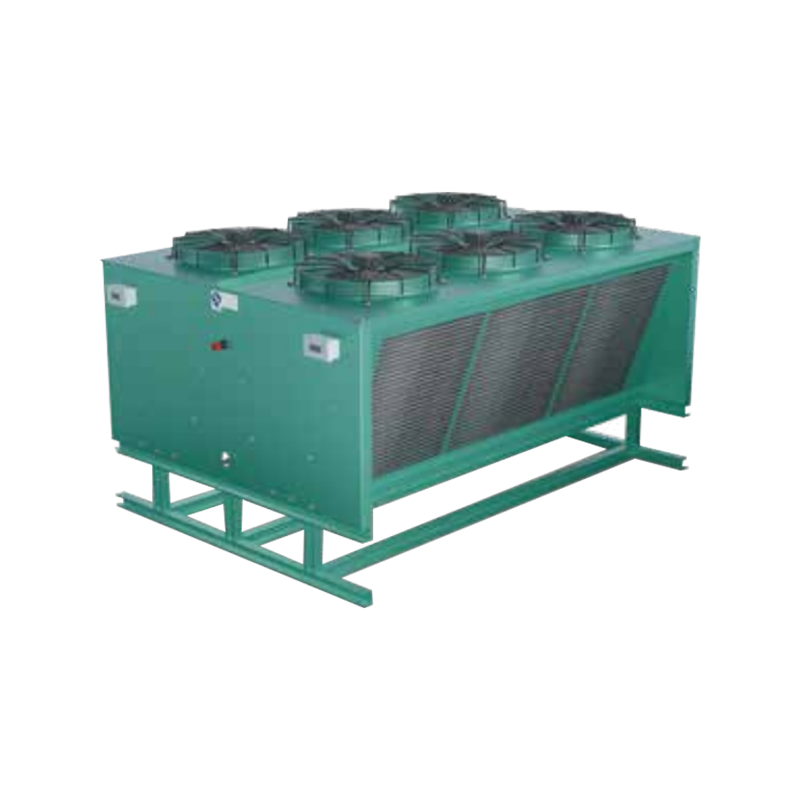 FNW Top Air Flow Air-Cooled CondenserTop-discharge condenser for compact sites, helping reduce hot-air recirculation while supporting common Freon refrigerants in large refrigeration systems.View Product →
That derating is predictable. A unit rated at 35 °C ambient typically gives up 1.8-2.5% of capacity for every kelvin above rating and draws more power at the same time, so a 43 °C afternoon can leave a 300 kW machine delivering only 245-255 kW. Upward-discharge condensers that keep their own hot plume away from the coil inlet recover part of that loss on tight sites, and the sizing rules for air-cooled condensers start with exactly that recirculation check.
What Actually Erodes Air-Cooled Performance
- Ambient above the rating point. Capacity drops and specific power rises in the same hour, which is why peak demand charges catch owners by surprise.
- Coil fouling. A greasy or dusty coil lifts condensing temperature by 3-5 K, worth 8-12% extra compressor power and often invisible until someone reads the discharge pressure trend.
- Low ambient in winter. Below roughly 0 °C the unit needs fan cycling, variable-speed fans or head pressure control, otherwise the expansion valve starves and the compressor cycles.
- Layout. Clearances under 1.5 m between coil faces and a wall cut airflow and quietly turn a 45 °C design into a 48 °C one.
Water-Cooled Condensing Units Trade Plant Complexity for Lower Power
A water-cooled condensing unit held at 36 °C condensing temperature cuts compressor power by roughly 25-30% against a 45 °C air-cooled unit, and it only pays when the tower, pumps and water treatment are counted inside the comparison.
A cooling tower with a 4-5 K approach on a 30 °C wet-bulb day supplies water at 34-35 °C, which supports 36-38 °C condensing instead of 45-48 °C. The trade is operational: scale of 0.5 mm on tube walls can cost 5-8% efficiency, so water hardness, cycles of concentration and blowdown have to be managed rather than assumed. Owners who already have a tower loop usually find that the engineering case for water-cooled condensing units rests on hours of operation rather than on headline COP.
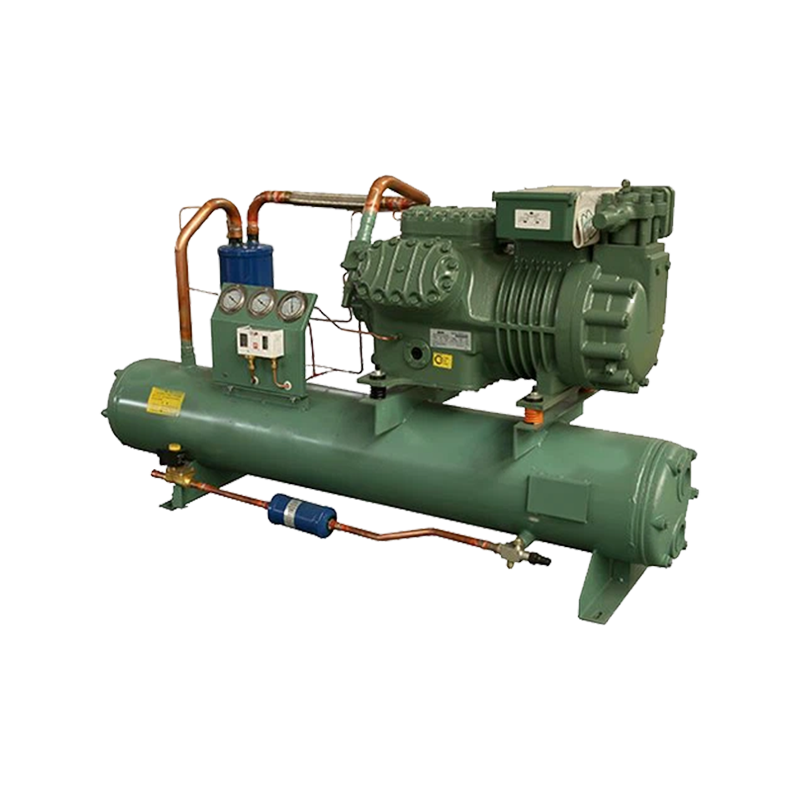 Water-Cooled Condensing Unit with Refrigeration ComponentsCustomizable water-cooled condensing unit with oil separator, controls, valves and gauges, suited to site-specific cooling requirements where tower water is available.View Product →
Side-by-Side Metrics for Air-Cooled vs Water-Cooled Condensing Units
The fastest way to settle the question is a single table built from site data, because most disagreements come from comparing an air-cooled catalogue rating with a water-cooled design condition.
| Metric | Air-cooled | Water-cooled |
| Condensing temperature | 45-48 °C | 35-38 °C |
| Electrical input per 100 kW cooling | 37-39 kW | 28-30 kW |
| Heat rejection auxiliaries | 3-5 kW of fans | 10-11 kW of tower fan and pumps |
| Make-up water | None | 1.3-2.0 L per kWh rejected |
| Installed cost premium | Baseline | 15-25% higher |
| Maintenance scope | Coil cleaning, fan motors | Water treatment, tube cleaning, tower service |
| Winter risk | Low-ambient head pressure control | Tower and pipe freeze protection |
| Best fit | Water-scarce sites, under 2,500 hours a year | High-hour plants with an existing water loop |
Where a tower loop already exists, dropping condensing temperature is often a condenser retrofit rather than a full unit change, and a shell-and-tube barrel matched to the compressor does most of the work.
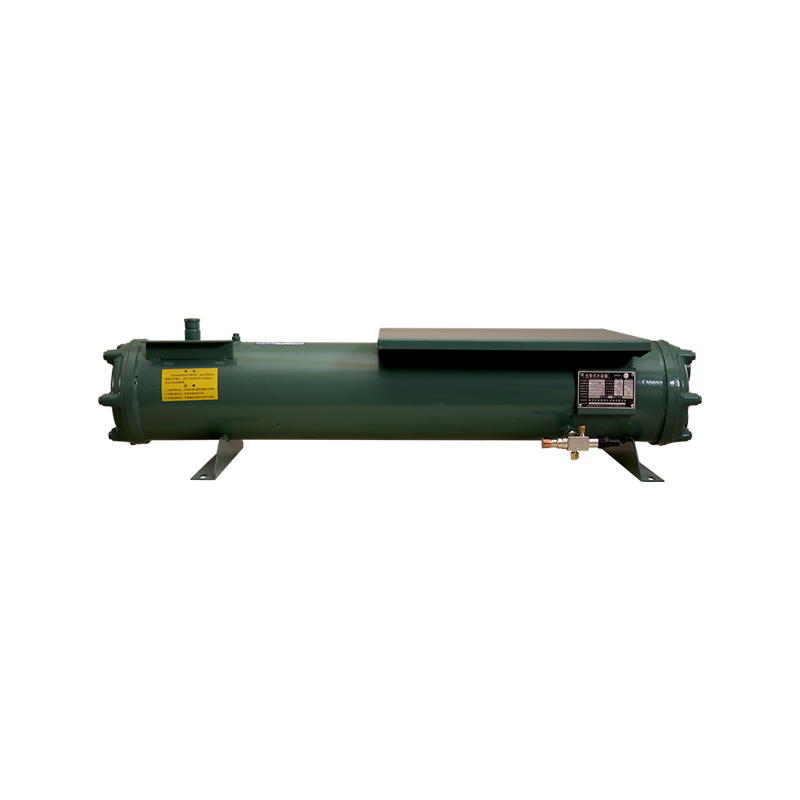 Shell-and-Tube Water-Cooled Condenser for RetrofitsCopper-tube, steel-shell condenser for refrigeration and air-conditioning loops, offered in multiple sizes for tower-based retrofits and space-limited installations.View Product →
Ten-Year Cost: Where Air-Cooled vs Water-Cooled Condensing Units Diverge
On the 300 kW, 4,000-hour example, the water-cooled option saves about USD 5,800 a year net of water, treatment and maintenance, which repays a USD 40,000 installed premium in roughly seven years.
The saving is not fixed. Electricity at USD 0.20 per kWh widens the annual gap to about USD 14,000 and pulls payback under three years. Water at USD 6 per cubic metre, or a tower that needs a full chemical programme, can shrink the advantage to USD 2,000 and stretch payback past fifteen years.
Site Conditions That Flip the Decision
Two site facts usually decide the matter before the efficiency curves are opened: how many hours the plant runs and what water really costs once treatment and discharge are included.
Choose Air-Cooled When
- Water is rationed, above USD 2.50 per cubic metre, or discharge is restricted.
- Annual run hours stay under 2,500, as in seasonal packing or short campaign work.
- Winter ambient regularly drops below 0 °C and nobody wants tower freeze protection.
- The unit is a retrofit with no plant room and no roof structure for a tower.
Choose Water-Cooled When
- The plant runs 5,000 hours or more a year on a steady base load.
- A cooling tower or open water loop is already on site and paid for.
- Electrical capacity, not floor space, is the binding constraint on expansion.
- Loads exceed 400 kW, where the 9 K condensing gap is worth tens of thousands of kWh.
One practical hybrid deserves a mention: keep the air-cooled unit for shoulder seasons and base load, and add a water-cooled circuit only for peak pull-down. It complicates controls but protects both capital and capacity.
Frequently Asked Questions
Is a water-cooled condensing unit always more efficient than an air-cooled one?
No. It is more efficient at the compressor because condensing temperature is lower, but once tower fans, pumps and water treatment are added the system advantage narrows to roughly 20-25% on a well-run site, and it disappears if the tower is poorly maintained or the water is hard.
How much water does a water-cooled condensing unit consume?
Budget 1.3 to 2.0 litres of make-up water per kWh of heat rejected, including blowdown. For a 300 kW plant rejecting about 380 kW over 4,000 hours, that is around 2,270 cubic metres a year, which is why local water pricing decides most of these projects.
What ambient temperature should I use to size an air-cooled condensing unit?
Use the 1% summer design dry-bulb for the site, not the catalogue's 35 °C reference, and add 2-3 K for coil recirculation if units sit in a row. Sizing at 43 °C instead of 35 °C typically costs 12-15% more capacity but prevents summer shortfalls.
Can an existing air-cooled plant be converted to water-cooled later?
Sometimes. The compressor and receiver can often be retained while the finned coil is replaced with a shell-and-tube condenser, provided the compressor's motor load and controls accept the lower condensing pressure. Check the compressor envelope first; retrofits fail on minimum condensing limits more often than on pipework.