


 English
 русский
In the backbone of modern industry, from food processing and chemical manufacturing to pharmaceuticals and data centers, reliable temperature control is non-negotiable. At the heart of this critical infrastructure lies industrial refrigeration equipment. This guide delves deep into the complexities of these systems, exploring their core components, various types, and key considerations for selection and maintenance. As China Custom Refrigeration Evaporator Equipment Manufacturers and Industrial Refrigeration Equipment Suppliers, Zhejiang Jinhao Refrigeration Equipment Co., Ltd. understands that the right system is not just a purchase but a long-term investment in operational stability, energy efficiency, and product quality. This comprehensive overview aims to provide facility managers, engineers, and decision-makers with the specific, in-depth information needed to navigate this essential field.
Content
- 1 Core Components of an Industrial Refrigeration System
- 2 Main Types of Industrial Refrigeration Systems
- 3
- 4 Key Applications and Industry-Specific Needs
- 5 Critical Factors in Selecting Industrial Refrigeration Equipment
- 6 Enhancing Efficiency and Sustainability
- 7 Installation and Long-Term Maintenance Best Practices
- 8 Frequently Asked Questions (FAQ)
- 8.1 1. What is the typical lifespan of industrial refrigeration equipment?
- 8.2 2. How often should industrial refrigeration systems be serviced?
- 8.3 3. What are the key trends in industrial refrigeration technology?
- 8.4 4. Can existing older systems be upgraded for better efficiency?
- 8.5 5. How critical is proper insulation for refrigeration efficiency?
- 9 Conclusion
- 10 References
Core Components of an Industrial Refrigeration System
An industrial refrigeration system is a sophisticated assembly of specialized components working in unison. Understanding each part's function is crucial for system design, troubleshooting, and optimization.
1. The Compressor: The Heart of the System
Often called the system's heart, the compressor increases the pressure and temperature of the refrigerant gas.
- Function: Draws low-pressure vapor from the evaporator and compresses it into a high-pressure, high-temperature gas.
- Key Types: Screw compressors, reciprocating (piston) compressors, and scroll compressors.
- Selection Factor: Choice depends on required capacity, efficiency targets, and duty cycle.
2. The Condenser: Releasing System Heat
The condenser's role is to reject the heat absorbed from the refrigerated space and added by the compressor to the environment.
- Function: Cools the high-pressure refrigerant gas, causing it to condense into a high-pressure liquid.
- Common Types: Air-cooled, water-cooled, and evaporative condensers.
3. The Expansion Device: Controlling Refrigerant Flow
This component regulates the flow of liquid refrigerant into the evaporator.
- Function: Creates a pressure drop, causing the refrigerant to cool rapidly as it enters the evaporator.
- Examples: Thermal expansion valves (TXVs), electronic expansion valves (EXVs), and capillary tubes.
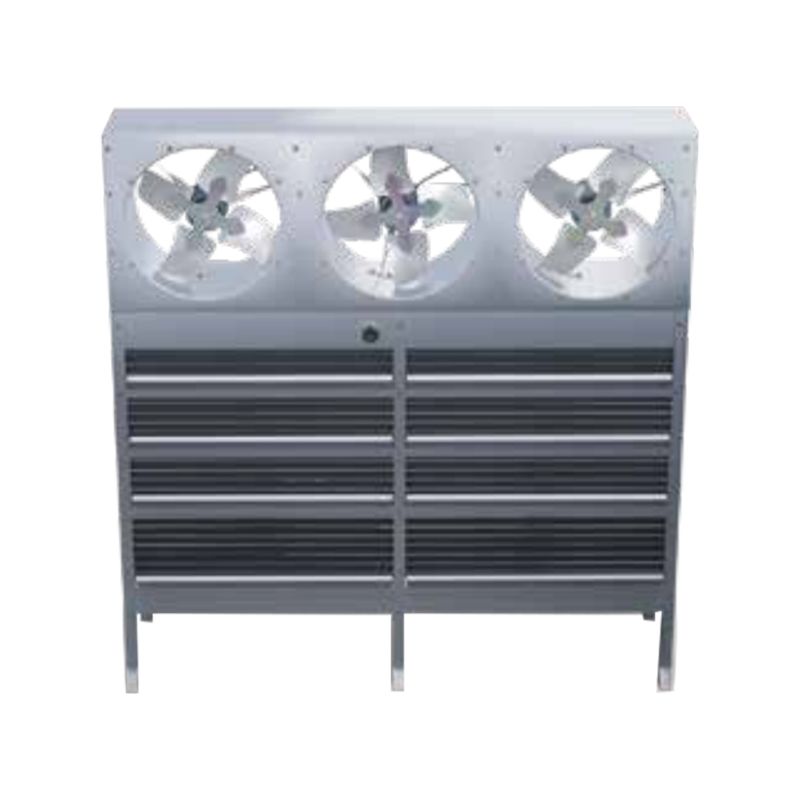
4. The Evaporator: Where Cooling Happens
As custom refrigeration evaporator equipment manufacturers, we emphasize the evaporator's critical role. It is the component where the actual cooling or freezing of the process or space occurs.
- Function: The low-pressure, cold refrigerant absorbs heat from the surrounding medium (air, water, or process fluid), causing it to boil and vaporize.
- Design Variations: Air coils, liquid chillers, and plate heat exchangers, often customized for specific applications.
Main Types of Industrial Refrigeration Systems
Selecting the right system architecture is fundamental to meeting specific operational demands. The two primary categories are direct and indirect systems, each with distinct advantages.
Direct Expansion (DX) vs. Indirect (Liquid Overfeed) Systems
A crucial decision in system design is choosing between a direct expansion (DX) and an indirect, or liquid overfeed, system. The table below highlights their key operational differences.
| Feature | Direct Expansion (DX) System | Indirect (Liquid Overfeed) System |
| Refrigerant Path | Refrigerant evaporates directly in the coils cooling the space or product. | A secondary coolant (e.g., glycol, brine) is chilled by the refrigerant and circulated to cool the space or product. |
| Complexity & Cost | Generally simpler and lower initial cost for smaller applications. | More complex with higher initial investment but often better for large, distributed cooling loads. |
| Safety & Leak Risk | Higher risk if a large refrigerant charge leaks into a occupied space. | Confines primary refrigerant to machinery room, reducing risk in process areas. |
| Efficiency & Control | Can be highly efficient but may suffer from poor refrigerant distribution in large coils. | Excellent refrigerant distribution and temperature control, leading to stable performance. |
For operations prioritizing safety in occupied spaces or requiring precise, stable temperatures over large areas, ammonia refrigeration system design for cold storage often utilizes indirect principles, even when using other refrigerants, to mitigate risk and enhance control.
Common Refrigerants and Their Applications
The choice of refrigerant is pivotal, impacting efficiency, safety, and environmental compliance.
- Ammonia (R717): A natural refrigerant with excellent efficiency and zero ODP/GWP. Used extensively in large food processing and cold storage. Requires specialized ammonia refrigeration system design for cold storage due to its toxicity and flammability.
- Hydrofluorocarbons (HFCs) e.g., R-134a, R-404A: Common in commercial and some industrial applications. Face phase-downs due to high Global Warming Potential (GWP).
- Hydrofluoroolefins (HFOs) & Blends: Newer generation with low GWP, serving as replacements for HFCs.
- Carbon Dioxide (CO2 / R744): Used in cascade or transcritical systems, especially in supermarkets and increasingly in industrial settings, offering a sustainable alternative [1].
Key Applications and Industry-Specific Needs
Industrial refrigeration equipment is not one-size-fits-all. System requirements vary dramatically across sectors.
Food and Beverage Processing
This industry demands stringent temperature control for safety, quality, and shelf-life.
- Requirements: Rapid chilling/freezing (blast freezers), precise temperature zones, and hygiene-compliant designs.
- System Focus: Reliability and sanitary design are paramount to prevent spoilage and ensure compliance.
Cold Storage Warehousing
Warehouses require consistent temperatures over vast volumes, making efficiency a primary driver of operating costs.
- Requirements: Even air distribution, energy-efficient components, and robust defrost management for low-humidity environments.
- System Focus: A well-engineered cold storage refrigeration unit maintenance checklist is critical for preventing downtime and optimizing energy use in these large-scale facilities.
Chemical & Pharmaceutical Manufacturing
Process cooling often requires precise temperature control for chemical reactions or product stability.
- Requirements: Extreme temperature ranges (from cryogenic to moderate cooling), explosion-proof components, and high-purity standards.
- System Focus: Custom-designed chillers and heat exchangers are frequently needed to meet exact process specifications.
Critical Factors in Selecting Industrial Refrigeration Equipment
Making an informed selection requires a thorough analysis of multiple technical and operational factors. One of the most common inquiries we address is how to choose an industrial chiller for a manufacturing plant, a process that embodies these key considerations.
1. Assessing Cooling Load and Capacity
- Calculation is Key: The total heat load (product load, insulation loss, internal heat, etc.) must be accurately calculated.
- Safety Margin: Systems are typically sized with a 10-20% capacity buffer for peak loads and future expansion.
- Impact of Undersizing: Leads to inability to maintain temperature, product loss, and compressor wear.
- Impact of Oversizing: Causes short cycling, reduced efficiency, higher costs, and poor humidity control.
2. Energy Efficiency and Total Cost of Ownership (TCO)
The initial purchase price is only a fraction of the system's lifetime cost. Energy consumption is the dominant expense.
- Key Metrics: Look for COP (Coefficient of Performance) and IEER (Integrated Energy Efficiency Ratio) ratings.
- Efficient Components: Variable Speed Drives (VSDs) on compressors and fans, high-efficiency evaporators and condensers.
- TCO Analysis: Evaluates initial cost, installation, energy consumption, maintenance, and disposal over the system's life.
3. Reliability, Maintenance, and Service Support
Downtime in an industrial setting can be catastrophic. Proactive maintenance is the best strategy.
- Design for Reliability: Robust components, redundancy for critical systems, and ease of access for servicing.
- Preventive Maintenance: Adherence to a detailed cold storage refrigeration unit maintenance checklist prevents minor issues from escalating.
- Technical Support: Access to knowledgeable service and parts supply is essential for minimizing downtime.
Enhancing Efficiency and Sustainability
Modern industrial refrigeration equipment offers numerous pathways to reduce environmental impact and operating costs.
Heat Recovery and System Integration
Waste heat from the condenser can be a valuable resource.
- Applications: Pre-heating process water, space heating, or desiccant regeneration.
- Benefit: Significantly improves overall system efficiency and reduces energy costs from other sources.
Advanced Controls and IoT Integration
Modern control systems are transforming plant management.
- Functions: Precise setpoint control, adaptive defrost cycles, remote monitoring, and predictive maintenance alerts.
- Outcome: Optimizes performance, reduces manual intervention, and provides valuable operational data. This is a key aspect of energy efficient industrial freezer installation tips, allowing systems to learn and adapt to usage patterns.
Leak Detection and Refrigerant Management
Minimizing refrigerant loss is both an economic and environmental imperative.
- Technology: Automated leak detection sensors can trigger alarms at the earliest sign of loss.
- Practice: Regular leak checks and proper refrigerant recovery procedures during service are mandatory.
Installation and Long-Term Maintenance Best Practices
Proper implementation is as important as the equipment itself. Following energy efficient industrial freezer installation tips from the outset sets the foundation for a system's lifetime performance.
Professional Installation and Commissioning
- Foundation & Leveling: Ensures proper compressor and component alignment, preventing vibration and wear.
- Refrigerant Piping: Must be clean, dry, and brazed correctly to prevent contamination and leaks.
- Electrical Connections: Proper sizing and secure connections are vital for safety and reliable operation.
- System Commissioning: A formal process to verify design, test all functions, and set optimal operating parameters.
Essential Maintenance Routines
A disciplined maintenance schedule extends equipment life and safeguards efficiency. Understanding what are the common problems with industrial refrigeration compressors helps focus these routines.
- Daily/Weekly: Log system pressures, temperatures, and unusual sounds.
- Monthly/Quarterly: Clean condenser coils, check refrigerant levels, inspect electrical connections, and verify safety controls.
- Annually: Comprehensive inspection, oil analysis for compressors, calibration of sensors and controls, and leak testing.
Troubleshooting Common Issues
Early diagnosis prevents major failures. What are the common problems with industrial refrigeration compressors and other components?
| Symptom | Possible Cause | Action |
| High Discharge Temperature | Insufficient condenser cooling, low refrigerant charge, non-condensables. | Clean condenser, check charge, purge system if needed. |
| Low Cooling Capacity | Dirty evaporator/condenser, low refrigerant, faulty expansion valve, compressor wear. | Clean coils, check charge and valve operation, assess compressor. |
| Excessive Frost on Evaporator | Defrost system failure, low airflow, stuck defrost drain. | Check defrost heaters, timers, fans, and drains. |
| Unusual Compressor Noise | Mechanical wear, liquid floodback, loose mounting. | Immediately investigate; may require professional service. |
Frequently Asked Questions (FAQ)
1. What is the typical lifespan of industrial refrigeration equipment?
With proper design, installation, and maintenance, major components like compressors and vessels can last 15-20 years or more. System longevity heavily depends on adherence to a rigorous maintenance schedule and operating within design specifications.
2. How often should industrial refrigeration systems be serviced?
Service frequency depends on runtime, criticality, and environment. A basic guideline includes quarterly inspections (cleaning, leak checks) and a comprehensive annual overhaul. Systems in harsh environments or 24/7 operation may require more frequent attention.
3. What are the key trends in industrial refrigeration technology?
Major trends include the shift to low-GWP natural refrigerants like CO2 and ammonia, the integration of IoT for predictive maintenance and data analytics, widespread adoption of variable speed technology for efficiency, and advanced heat recovery systems to improve overall plant sustainability [2].
4. Can existing older systems be upgraded for better efficiency?
Yes, often through retrofits. Common upgrades include adding variable frequency drives (VFDs) to compressors and fans, installing high-efficiency evaporator and condenser coils, updating to electronic expansion valves, and modernizing the control system. A professional assessment is needed to determine cost-effectiveness.
5. How critical is proper insulation for refrigeration efficiency?
Extremely critical. Inadequate or damaged insulation on piping, cold rooms, and vessels significantly increases the system's heat load, forcing compressors to work harder and longer. Ensuring insulation integrity and using appropriate thickness is a fundamental and highly cost-effective energy efficient industrial freezer installation tip and maintenance practice.
Conclusion
Selecting, operating, and maintaining industrial refrigeration equipment is a complex but manageable task that demands technical knowledge and strategic planning. From understanding the nuances of ammonia refrigeration system design for cold storage to implementing a thorough cold storage refrigeration unit maintenance checklist, each decision impacts performance, cost, and reliability. Key steps like knowing how to choose an industrial chiller for a manufacturing plant, applying energy efficient industrial freezer installation tips, and being able to diagnose what are the common problems with industrial refrigeration compressors are integral to successful operations. As a comprehensive manufacturer integrating R&D, manufacturing, and operation, Zhejiang Jinhao Refrigeration Equipment Co., Ltd. is committed to providing not just high-quality equipment but also the expertise to ensure these critical systems deliver optimal value over their entire lifecycle. Informed investment and proactive care are the cornerstones of efficient, reliable, and sustainable industrial refrigeration.
References
[1] Pearson, A. (2021). Carbon Dioxide as a Refrigerant: The Transition to Sustainable Systems. *International Journal of Refrigeration*, 130, 313-321.
[2] International Institute of Refrigeration (IIR). (2023). *Trends in Industrial Refrigeration: Energy Efficiency and Sustainability*. Retrieved from IIR Publications.