


 English
 русский
Content
- 1 What Are Evaporative Coolers?
- 2 How Does an Evaporative Cooler Work?
- 3 What Is a Portable Evaporative Cooler and How Does It Work?
- 4 Evaporative Cooler vs. Air Conditioner: Key Differences
- 5 Evaporative Cooler vs. Fan: What's the Difference?
- 6 Does Evaporative Cooling Actually Work?
- 7 Cost of Evaporative Cooling Systems
What Are Evaporative Coolers?
An evaporative cooler is a device that lowers air temperature by passing warm outside air over water-saturated pads, causing the water to evaporate and absorb heat from the airstream. The result is a stream of cool, humidified air delivered into a space. Unlike refrigerant-based air conditioners, evaporative coolers require no compressor, no condenser coil, and no chemical refrigerant — the entire cooling effect is produced by the natural physics of water evaporation.
"Swamp cooler" is simply a colloquial name for the same device. The two terms are completely interchangeable. The nickname is thought to have originated in the American Southwest, where evaporative coolers are widely used, and may refer ironically to the damp, humid output air — or to early models that developed mold and musty odors when not maintained. In technical, commercial, and HVAC industry contexts, "evaporative cooler" is the standard terminology.
Evaporative cooling is one of the oldest cooling methods known to humans. Ancient Egyptians hung wet reeds in doorways to cool incoming breezes, and the principle has been used in one form or another for thousands of years. Modern units are engineered versions of that same fundamental process.
How Does an Evaporative Cooler Work?
The operating principle behind evaporative cooling is straightforward: when water evaporates, it transitions from liquid to vapor, and that phase change requires energy. That energy is drawn directly from the surrounding air in the form of heat, reducing the air temperature in the process. The thermodynamic term for this is adiabatic cooling — no external heat source or sink is involved, only the internal energy transfer driven by evaporation.
Inside a standard evaporative cooler, the process works as follows:
- A pump draws water from a reservoir in the base of the unit and circulates it up to a distribution header at the top of the cooling pads.
- Water trickles down through the pads — typically made of cellulose, aspen fiber, or rigid synthetic media — saturating them evenly.
- A fan draws warm outside air horizontally through the wet pads. As the air passes through, moisture evaporates from the pad surface, absorbing heat from the air and dropping its temperature by anywhere from 15°F to 40°F (8°C to 22°C) depending on conditions.
- The now-cooled, humidified air is pushed into the living or working space through a duct outlet or directly from the unit.
- Excess water that does not evaporate drains back into the reservoir to be recirculated.
The effectiveness of this process is directly tied to the relative humidity of the incoming air. Air that is already heavily laden with moisture has limited capacity to absorb more, so evaporation slows and the temperature drop is smaller. Dry air, by contrast, absorbs evaporated water rapidly, producing a much larger cooling effect. This is why evaporative coolers perform exceptionally well in arid climates and struggle in humid ones.
What Is a Portable Evaporative Cooler and How Does It Work?
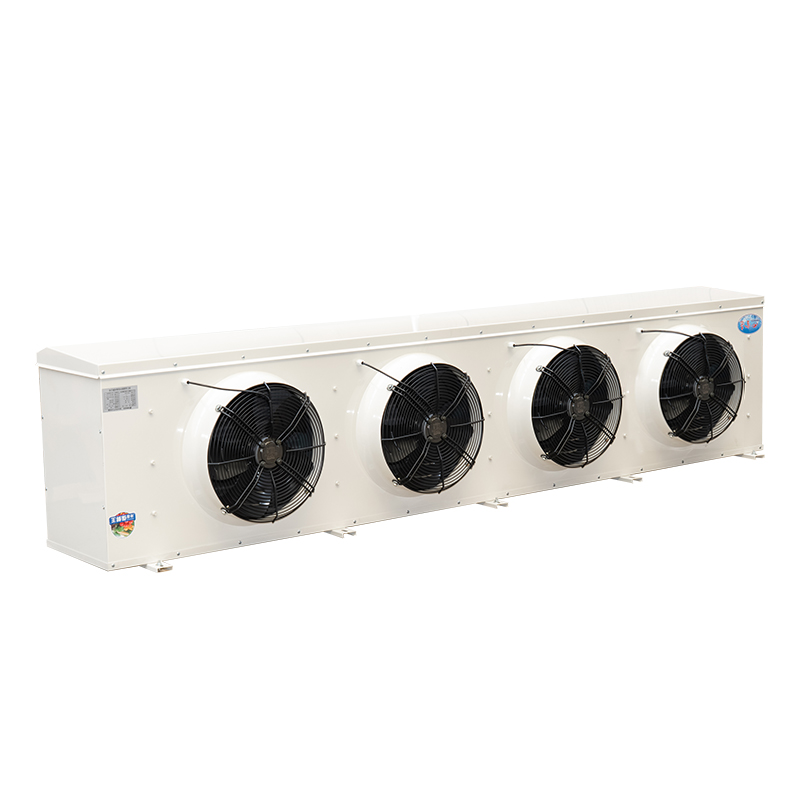
A portable evaporative cooler is a self-contained, freestanding unit on casters that can be moved from room to room without any permanent installation. It includes an internal water tank (typically 5 to 20 liters), a pump, cooling pads, and a fan, all housed in a single cabinet that plugs into a standard wall outlet.
The cooling mechanism is identical to that of a whole-house unit — warm room air is drawn through wet pads and discharged as cooler air — but there are important operational differences:
- Ventilation requirement: Because evaporative coolers add moisture to the air, a portable unit needs a source of fresh, dry air and a way for humid air to exit the room. Operating a portable evaporative cooler in a fully sealed room causes humidity to rise rapidly, which both reduces cooling efficiency and creates discomfort. A slightly open window or door resolves this.
- Tank refilling: Unlike ducted systems connected to a water line, portable units have finite water tanks that need to be manually refilled every few hours during continuous operation.
- Cooling area: Portable units are best suited for single rooms or personal cooling zones up to roughly 300–500 square feet. They are not designed to condition an entire home.
- Power consumption: Most portable evaporative coolers draw between 40 and 200 watts — a fraction of what a window air conditioner uses for the same room size.
Portable evaporative coolers are popular for spot cooling in workshops, garages, patios, server rooms, and home offices, particularly in dry climates where a full AC installation is unnecessary or impractical.
Evaporative Cooler vs. Air Conditioner: Key Differences
Evaporative coolers and air conditioners both lower indoor air temperature, but they operate on fundamentally different principles and are suited to different environments. Understanding the distinction helps clarify which technology is appropriate for a given situation.
| Feature | Evaporative Cooler | Air Conditioner |
|---|---|---|
| Cooling method | Water evaporation | Vapor-compression refrigeration |
| Effect on humidity | Increases indoor humidity | Reduces indoor humidity |
| Best climate | Hot and dry (below ~60% RH) | Any climate including humid |
| Energy use | 75–80% less than AC | High (compressor-driven) |
| Refrigerant | None | Required (HFCs, R-410A, etc.) |
| Ventilation needed | Yes — requires fresh air supply | No — recirculates sealed air |
| Installation complexity | Low to moderate | Moderate to high |
| Purchase cost | Lower | Higher |
The most important distinction in real-world use is the humidity response. An air conditioner removes moisture from the air as a byproduct of cooling — the evaporator coil causes water to condense out of the airstream. This makes AC effective in humid climates. An evaporative cooler does the opposite: it adds moisture. In a location where outdoor humidity already sits at 70–80%, adding more moisture to indoor air makes conditions feel muggier and provides little measurable temperature drop.
Evaporative Cooler vs. Fan: What's the Difference?
A fan moves air but does not change its temperature. The cooling sensation produced by a fan is purely physiological — moving air accelerates the evaporation of perspiration from skin, which makes a person feel cooler even though the room temperature is unchanged. The moment you leave the airflow, the sensation disappears.
An evaporative cooler actually reduces the temperature of the air it delivers. The discharge air from a properly operating evaporative cooler in dry conditions can be 15°F to 40°F cooler than the ambient air being drawn in. That cooler air lowers the actual room temperature over time, not just the perceived temperature. In a well-ventilated space on a hot, dry day, an evaporative cooler produces a measurable and sustained reduction in indoor temperature — something a fan alone cannot accomplish.
That said, evaporative coolers do use a fan internally as part of their mechanism, and many units offer a fan-only mode that bypasses the water pump for use on cooler days or in higher-humidity conditions when evaporative cooling would be less effective.
Does Evaporative Cooling Actually Work?
Yes — under the right conditions, evaporative cooling is highly effective. The critical variable is wet-bulb depression: the difference between the dry-bulb (actual) air temperature and the wet-bulb temperature, which reflects how much moisture the air can still absorb. A large wet-bulb depression means dry air with strong evaporative cooling potential; a small or zero depression means the air is near saturation and evaporation is negligible.
As a general guideline:
- Below 40% relative humidity — Evaporative cooling works very well. Temperature drops of 20°F–35°F are achievable. Regions like Arizona, New Mexico, Nevada, parts of California, and much of the Middle East, Australia, and Central Asia fall into this category for most of the summer.
- 40–60% relative humidity — Evaporative cooling still provides useful cooling but with a smaller temperature drop, typically 10°F–20°F. Comfort improvement is noticeable but not as dramatic.
- Above 60–70% relative humidity — Cooling effect diminishes significantly. At 80% or higher, an evaporative cooler adds humidity without meaningfully reducing temperature and may make conditions feel worse, not better.
For residents of humid climates — the Gulf Coast, Florida, the southeastern United States, Southeast Asia, or tropical coastal regions — evaporative cooling is generally not a viable primary cooling solution. For those in dry inland climates, it can be the most cost-effective and energy-efficient option available.
Cost of Evaporative Cooling Systems
Evaporative coolers are substantially less expensive than central air conditioning in both upfront cost and ongoing operating cost, which is a major reason for their popularity in appropriate climates.
Purchase and Installation Costs
- Portable evaporative coolers range from $50 to $400 for residential units, with commercial and industrial models running $500 to $3,000 or more depending on airflow capacity.
- Window-mounted evaporative coolers typically cost $200 to $700 for the unit, plus $100 to $300 for professional installation if needed.
- Whole-house rooftop or side-mounted systems generally cost $700 to $2,500 for the unit, with total installed costs including ductwork and electrical connections running $1,500 to $4,500 for an average home. By comparison, a central AC system for the same home typically costs $5,000 to $12,000 installed.
Operating Costs
A whole-house evaporative cooler typically consumes 300 to 700 watts of electricity — compared to 3,000 to 5,000 watts for a central air conditioner of equivalent capacity. At an average U.S. electricity rate of $0.16 per kWh, running an evaporative cooler eight hours a day for a three-month cooling season costs roughly $35 to $80 in electricity. The equivalent central AC bill for the same period would often be $300 to $600 or more.
Maintenance Costs
Annual maintenance for an evaporative cooler is modest. Cooling pads typically need replacement once per season at a cost of $20 to $80 depending on unit size and pad type. Water distribution lines, pumps, and float valves occasionally need servicing. Total annual maintenance costs for a whole-house unit usually run $50 to $200 — far less than the refrigerant recharges, coil cleaning, and compressor maintenance that AC systems require.