


 English
 русский
A 0 °C meat chiller and a -5 °C staging room can sit six metres apart in the same plant and still need two different evaporators. Fit a DD medium-temperature air cooler into the warmer room and the coil bridges with frost inside a shift. Fit a DL high-temperature unit into the colder one and the room never pulls down while the defrost timer runs for nothing.
DD vs DL air coolers is a comparison of application bands, not of build quality. A DD coil is made for medium-temperature rooms between roughly -18 °C and -5 °C; a DL coil is made for high-temperature rooms from about -5 °C up to +10 °C. Both are ceiling-mounted evaporators from the same product families, often built in the same plant: Zhejiang Jinhao Refrigeration Equipment Co. Ltd. lists DD and DL units side by side in one catalogue, which is exactly why so many buyers assume the difference is only a model number.
Content
- 1 DD vs DL Air Coolers: The Room Temperature Band Sets Everything
- 2 How to Compare DD and DL Air Coolers in Four Checks
- 3 Fin Spacing: The Measurable Line Between the Two Classes
- 4 Nameplate Capacity Is Not a Comparison
- 5 Defrost and Moisture: The Cost That Arrives in Month Three
- 6 Frequently Asked Questions About DD and DL Air Coolers
DD vs DL Air Coolers: The Room Temperature Band Sets Everything
A DD air cooler serves medium-temperature rooms from about -18 °C to -5 °C. A DL air cooler serves high-temperature rooms from about -5 °C to +10 °C. Fix that band first, because every other comparison point moves with it.
Two physical facts drive the split. A warmer room means a warmer evaporating temperature, so the gap between room air and coil surface, the design TD, shrinks and the coil needs more surface and more air to move the same heat. A warmer room also carries more moisture, and moist air against a tight coil means fast frost.
| Design parameter | DD medium temperature | DL high temperature |
| Room temperature | -18 °C to -5 °C | -5 °C to +10 °C |
| Evaporating temperature | -25 °C to -10 °C | -10 °C to 0 °C |
| Fin spacing | 6.0 mm to 8.0 mm | 4.5 mm to 6.0 mm |
| Design air-side TD | 8 K to 12 K | 6 K to 9 K |
| Airflow per kW of duty | Lower | Higher |
| Defrost interval, wet loading | 6 h to 12 h | 3 h to 6 h |
The last two rows catch most first-time buyers. A DL coil needs more air per kW because its coil-to-air difference is smaller, and it defrosts more often because a 4.5 mm fin gap fills long before a 7 mm gap does.
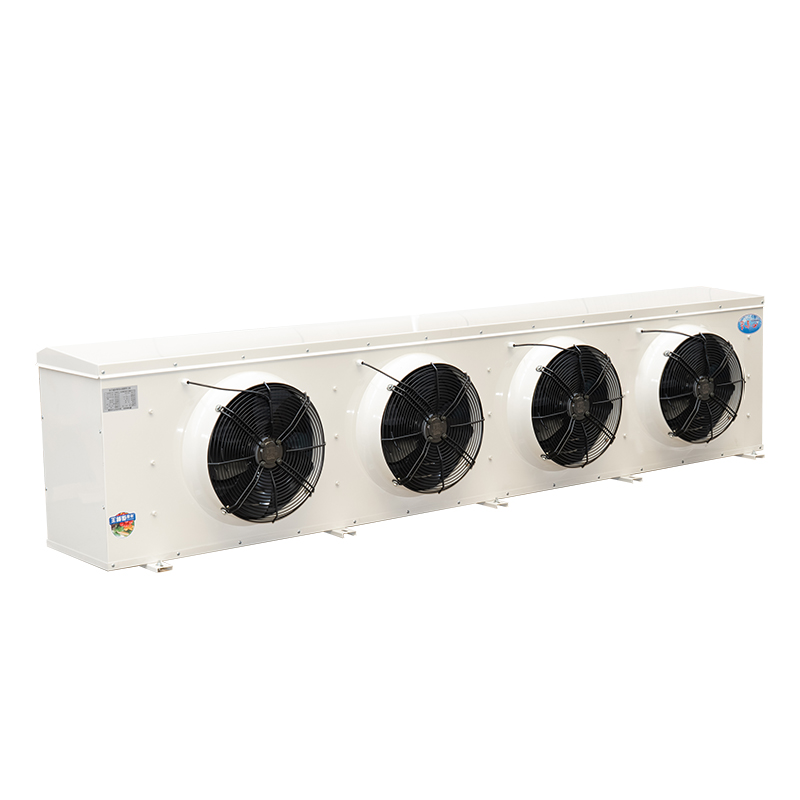 DD Type Medium-Temperature Ceiling Air CoolerFor medium-temperature cold storage around -18°C, this DD cooler uses 6 mm fin spacing, electric defrost and capacities from 1.4 to 81 kW.View Product →
How to Compare DD and DL Air Coolers in Four Checks
Compare four numbers before you compare price: design TD, fin spacing, airflow per kW and defrost cycles per day. If a supplier cannot quote the first two at your room condition, the quotation is not yet comparable.
- Lock the room condition. Temperature is half the brief. Relative humidity, product entry temperature and door traffic decide the frost load, and a 0 °C room holding wrapped pallets behaves nothing like a 0 °C room loading warm carcasses twice a day.
- Set the design TD. TD is room air temperature minus evaporating temperature. A DD coil in a -18 °C room running -28 °C evaporating works at 10 K; a DL coil in a +2 °C room at -6 °C evaporating works at 8 K. Ask for capacity at your TD, not the catalogue's.
- Size against frost, not against day one. Narrow fins buy surface that disappears once frost bridges the gap. Above roughly 8 g/kg moisture content, wider spacing beats the extra surface within the first month of operation.
- Match defrost to moisture load. Electric defrost on a DL coil in a wet room can run six to eight times a day; the same coil in a dry medium-temperature room may run twice.
Fin Spacing: The Measurable Line Between the Two Classes
Fin spacing is the fastest way to identify what a cooler was designed for. Below 6 mm means high-temperature duty with frequent defrost; above 6 mm means medium-temperature duty with room for frost to sit.
Measure the coil inside a DL housing and you will find 4.5 mm to 6 mm between fins. A DD coil usually measures 6 mm to 8 mm, and a low-temperature DJ coil runs wider still at 9 mm to 12 mm. The chart shows why those three classes cannot be swapped by changing a defrost setting.
Tighter spacing packs more surface into the same housing, which is the right trade in a 0 °C room where the coil-to-air gap is small and the coil must be large. Wider spacing gives frost somewhere to go, and on a medium-temperature coil at -18 °C that matters more than raw surface. The site's air cooler evaporator selection and maintenance guide walks through the same trade-off model by model.
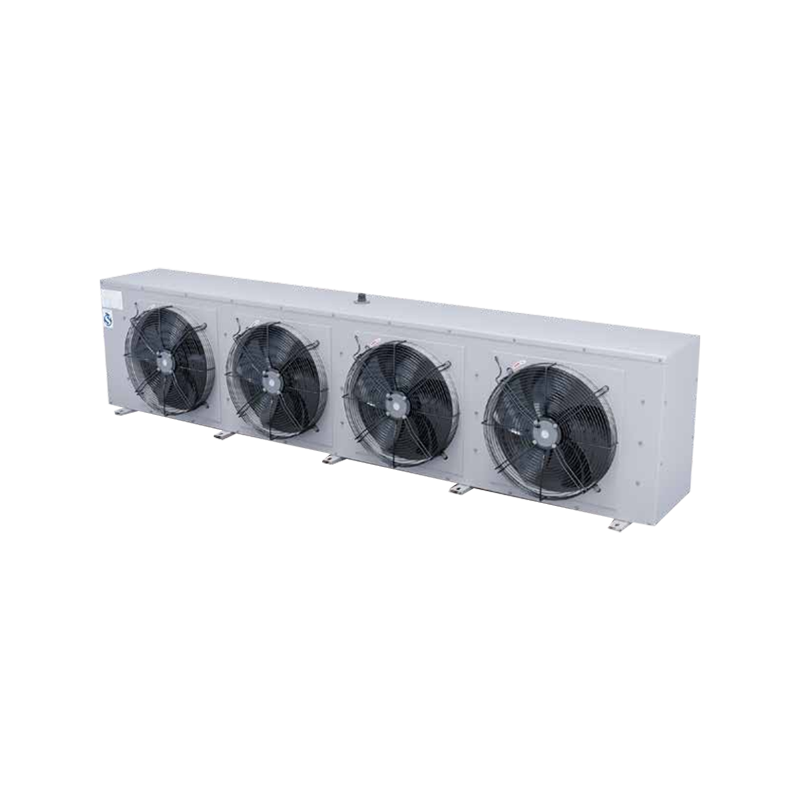 DL Type High-Temperature Ceiling Air CoolerFor rooms around 0°C, this DL ceiling cooler pairs 4.5 mm fin spacing with mechanically expanded aluminum fins and offers 2–116 kW capacities.View Product →
Nameplate Capacity Is Not a Comparison
A 12 kW DD rating and a 12 kW DL rating describe different work, so the two figures cannot be read side by side. Rated capacity depends on room temperature, evaporating temperature, refrigerant, superheat, airflow and fin condition.
Rating standards such as EN 328 and GB/T 25129 both anchor capacity to a declared set of conditions. When two catalogues declare different conditions, the kW differ for reasons unrelated to build quality. Re-rate both coils to your room temperature and your TD before any decision, and treat a quotation that omits the condition as a placeholder.
Compare like this
- Same room temperature and same TD
- Same refrigerant and superheat
- Same airflow at the stated static pressure
- Capacity quoted net of frost after six hours
Avoid this
- Catalogue kW read at different evaporating temperatures
- Price per kW with no rating condition attached
- Airflow quoted without external static pressure
- Defrost power left out of the running cost
A DL coil re-rated from a 0 °C room to a -18 °C room does not lose a few percent. It loses a large share of its capacity, then loses more as frost closes the fins, which is why the band in the first table is not a marketing label.
Defrost and Moisture: The Cost That Arrives in Month Three
In high-temperature rooms, defrost is the dominant running cost, not compressor power. Two coils with the same nominal capacity can part company by several thousand kilowatt-hours a year once cycles are counted.
- Every cycle adds heat. The coil has to remove, after defrost, the heat that defrost just put in, and that energy never appears on a capacity table.
- Tight fins shorten the interval. A 4.5 mm gap bridges faster, so the controller calls for defrost more often, so the penalty repeats.
- Water defrost suits wet rooms. Where moisture load is high and a drain is available, water defrost clears the same frost with far less heat gain than electric elements.
- Drain and trap design decides reliability. An undersized trap or a flat drain run turns a good defrost cycle into an ice block at the coil base.
Field rule of thumb: if a room loads warm product more than twice a day, budget defrost energy at 8 to 12 percent of total refrigeration energy and size the coil for the frosted condition, not the clean one.
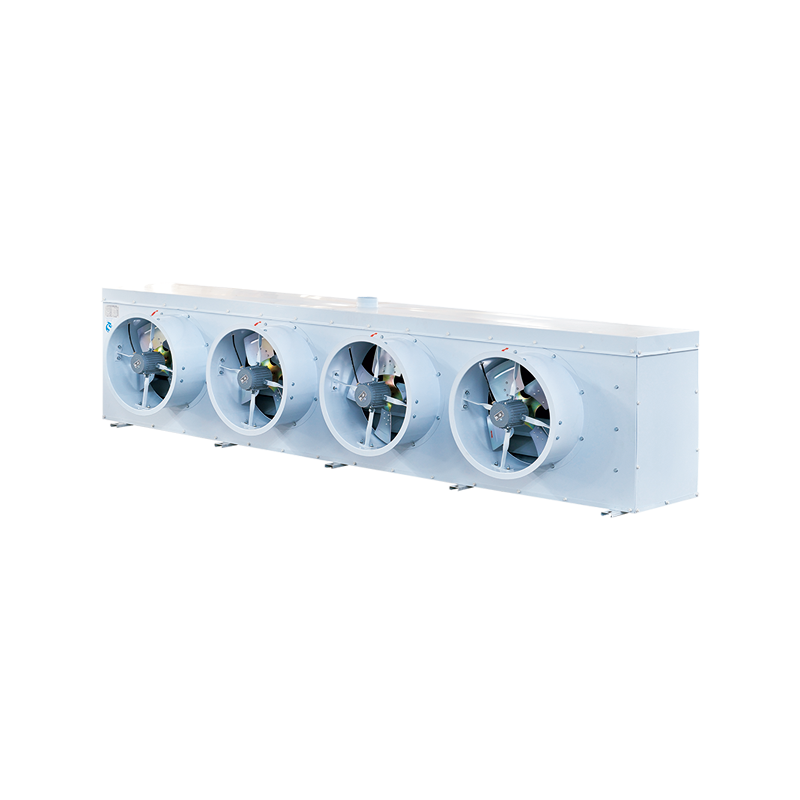 Water Defrost Air Cooler for Cold RoomsUseful where quick defrost or no electric defrost is needed, this water-defrost unit covers DLS, DDS and DJS room-temperature series from 7.3 to 116 kW.View Product →
Frequently Asked Questions About DD and DL Air Coolers
Can a DL air cooler be used in a -18 °C freezer?
No. The 4.5 mm to 6 mm fin spacing fills with frost within hours at that temperature, airflow collapses and capacity falls away. Use a DD coil for medium temperature and a DJ coil below -18 °C.
What room temperature separates DD from DL?
About -5 °C is the practical boundary. Below it, DD medium-temperature coils are the default; above it, DL high-temperature coils are. Between -8 °C and -2 °C the decision depends on moisture load and defrost method rather than on the number alone.
Which is more efficient, a DD or a DL air cooler?
Neither is more efficient in isolation. A DL coil runs at a warmer evaporating temperature, which raises compressor COP, but it also defrosts more often in humid rooms. Compare total energy per year at the same room condition.
How much fin spacing do I need for a 0 °C room?
Plan on 4.5 mm to 6 mm for a 0 °C room with normal loading, and move toward 6 mm or wider when product enters warm or door traffic is heavy. Wider spacing costs surface but holds capacity longer between defrosts.