


 English
 русский
A 10,000 m² frozen food warehouse operating at -25 °C does not just need cooling capacity. It needs air that reaches every pallet position. Zhejiang Jinhao Refrigeration Equipment Co. Ltd. manufactures both single-discharge and dual-discharge air coolers for this exact decision, and the choice between them often decides whether the room holds a tight +/- 0.5 °C or drifts toward a 3 °C spread. For large cold storage facilities, the comparison has to go deeper than fan count: air distribution and defrost efficiency are the two measures that ultimately control operating cost and product quality. The full air cooler evaporator product line is available from the Zhejiang Jinhao manufacturing base.
Content
- 1 Air Distribution Metrics for Dual-Discharge and Single-Discharge Air Coolers
- 2 How Dual-Discharge Air Coolers Improve Air Flow in Wide Rooms
- 3 When a Single-Discharge Air Cooler Is Still the Better Layout
- 4 Defrost Efficiency: What Really Changes Between the Two Designs
- 5 A Practical Selection Framework for Large Cold Storage Facilities
- 6 Frequently Asked Questions
Air Distribution Metrics for Dual-Discharge and Single-Discharge Air Coolers
Air distribution quality in large cold storage is governed by three measurable values: throw distance, air changes per hour, and temperature uniformity. Fan count is only a means to those ends.
When air leaves a unit cooler, it forms a jet that mixes with surrounding room air. The jet has enough velocity to carry it a certain distance before it slows below 0.5 m/s. Below that threshold, the air no longer mixes effectively, and warm pockets appear. This is why an air cooler with two small fans can outperform one large fan when the room shape is wide, and why a single large fan can cover a long corridor that two smaller fans cannot.
| Parameter | Dual-Discharge | Single-Discharge |
| Throw distance per outlet | 12 to 20 m | 25 to 35 m |
| Effective coverage width | 2x outlet throw | 1x outlet throw |
| Typical air changes per hour | 6 to 12 ACH | 5 to 10 ACH |
| Temperature uniformity | +/- 0.5 to +/- 1.0 °C | +/- 1.0 to +/- 2.0 °C |
| Best room configuration | Wide rooms with central racking | Long, narrow corridors |
How Dual-Discharge Air Coolers Improve Air Flow in Wide Rooms
Dual-discharge air coolers split the airflow into two outlet streams, creating twin circulation loops that fit wide rooms and rack aisles better than one directed jet.
The unit houses two fan groups that discharge air in opposite or perpendicular directions. Each stream forms its own circulation loop that returns to the central suction coil. Because the two loops interlock, the center of a broad room is no longer a dead zone. Pallet rack aisles receive airflow from both directions, which reduces product temperature gradients and slows surface moisture loss.
What a dual-discharge unit does best
- Two streams cover two rack aisles at the same time from a single unit
- Lower discharge velocity per outlet reduces food surface moisture evaporation
- Central suction coil draws return air evenly from both sides of the room
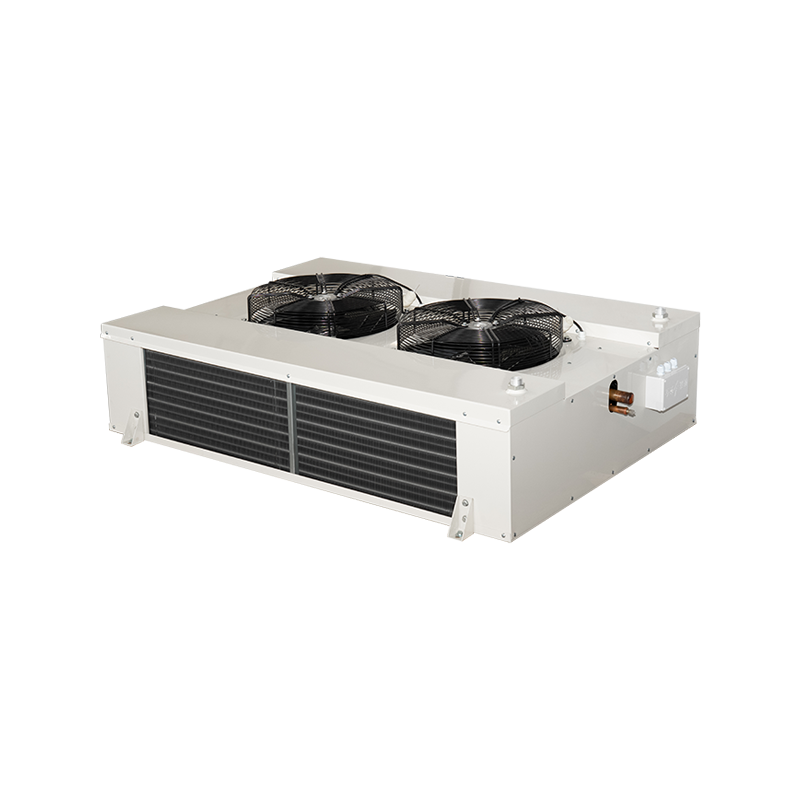 Dual Discharge Air Cooler for Large Cold RoomsThis unit uses two fan groups to discharge air in opposite directions, creating interlocking circulation loops that eliminate center dead zones and evenly cool pallet rack aisles, reducing temperature gradients and surface moisture loss.View Product →
For facilities where width is the primary dimension and racking runs parallel down the room, the dual-discharge layout reduces the number of units required compared with a single-direction model, because one unit feeds two aisles.
When a Single-Discharge Air Cooler Is Still the Better Layout
Single-discharge air coolers outperform dual-discharge models in long, narrow cold rooms because they throw one coherent jet over 25 to 35 meters.
All the fan energy passes through a single outlet face, which maximizes static pressure and throw distance. In a corridor-type room, one unit installed at the head of a bay can cover the full length. The coil block is a single continuous fin-tube assembly, which simplifies refrigerant distribution and makes the frost front progress evenly across the face during defrost.
Why long rooms still favor a single discharge
- Maximum throw distance per unit means fewer air coolers to install and maintain
- One continuous coil block produces more uniform frost formation
- Larger fin area per unit extends the interval between defrost cycles in low-frost-load rooms
A dual-discharge unit would waste half of its airflow against the side walls in this configuration.
Defrost Efficiency: What Really Changes Between the Two Designs
In low-temperature rooms, single-discharge air coolers usually finish a hot-gas defrost cycle faster, but dual-discharge units tend to defrost less frequently because their air movement keeps frost off the coil face longer.
Defrost performance depends on three factors: how evenly frost forms, how evenly defrost heat is distributed, and how quickly melt water drains away. Frost builds on the coil face where air velocity is lowest and humidity is highest. A single discharge face with one continuous coil block distributes hot gas or electric heater energy over one uniform surface, which produces a predictable defrost curve.
A dual-discharge unit presents two discharge faces. If one airflow loop is slightly warmer than the other, frost builds unevenly, and the thinner side of the coil clears before the other, wasting energy. The refrigerant distributor and heater wattage must be carefully balanced across both sections.
| Defrost Method | Dual-Discharge | Single-Discharge |
| Electric defrost cycle | 35 to 55 min | 25 to 45 min |
| Hot-gas defrost cycle | 25 to 40 min | 15 to 30 min |
| Water defrost cycle | 15 to 25 min | 12 to 20 min |
| Defrost interval | 8 to 14 h | 6 to 10 h |
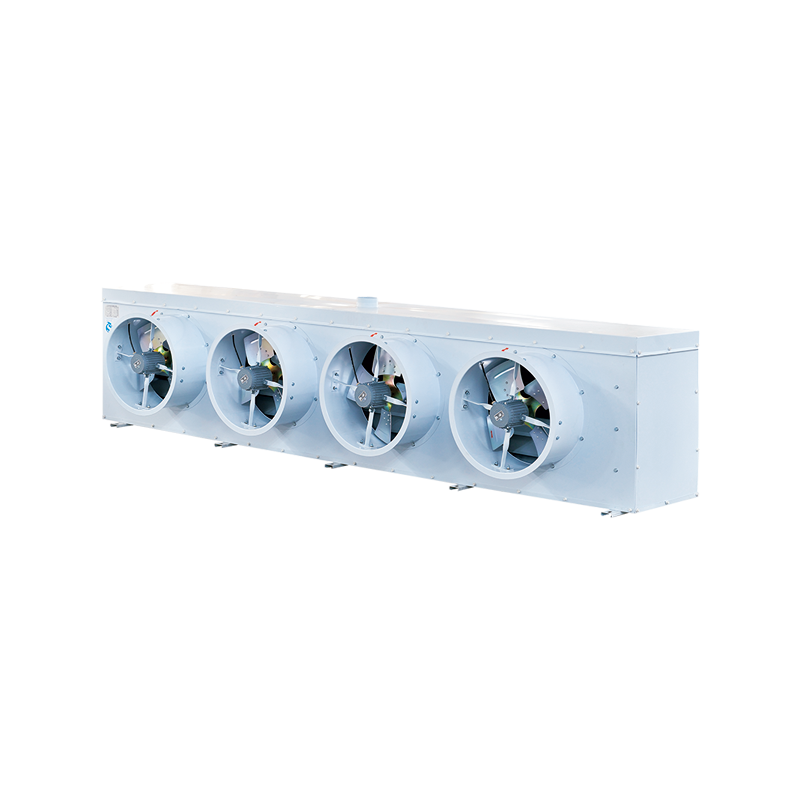 Water Defrost Air Cooler for Quick DefrostingDesigned for Freon systems needing rapid defrost, this cooler uses a water defrost process that saves time and maintains capacity. Its dual-discharge setup can have longer defrost intervals, offsetting cycle time by less downtime per day.View Product →
For rooms with heavy product loads and frequent door openings, the longer defrost interval of a dual-discharge unit can offset its longer cycle time, because each defrost event takes the room out of active cooling for a shorter share of the day.
A Practical Selection Framework for Large Cold Storage Facilities
Choose the discharge type based on room aspect ratio, racking layout, operating temperature, and defrost infrastructure, in that order.
- Calculate the room volume and peak refrigeration load from product throughput and door usage
- Determine the target air changes per hour from the product loading and target storage temperature
- Use the footprint shape to select dual-discharge for wide rooms or single-discharge for long, narrow bays
- Map the racking aisles to confirm the air path reaches both sides of each rack face
- Select the defrost method based on hot gas availability, electric power cost, and wash water supply
- Verify drain pan capacity and the ceiling suspension structural limit before ordering
Choose dual-discharge when
- Room width exceeds 60% of length
- Rack rows run parallel to the unit
- The room is split into wide open bays
Choose single-discharge when
- Room length is 3 to 5 times the width
- One loading corridor runs the full length
- Hot-gas defrost is the primary defrost method
For -25 °C frozen rooms, the low-temperature DJ-type air cooler line is often the right starting point, and the discharge style follows from the room shape, not the other way around.
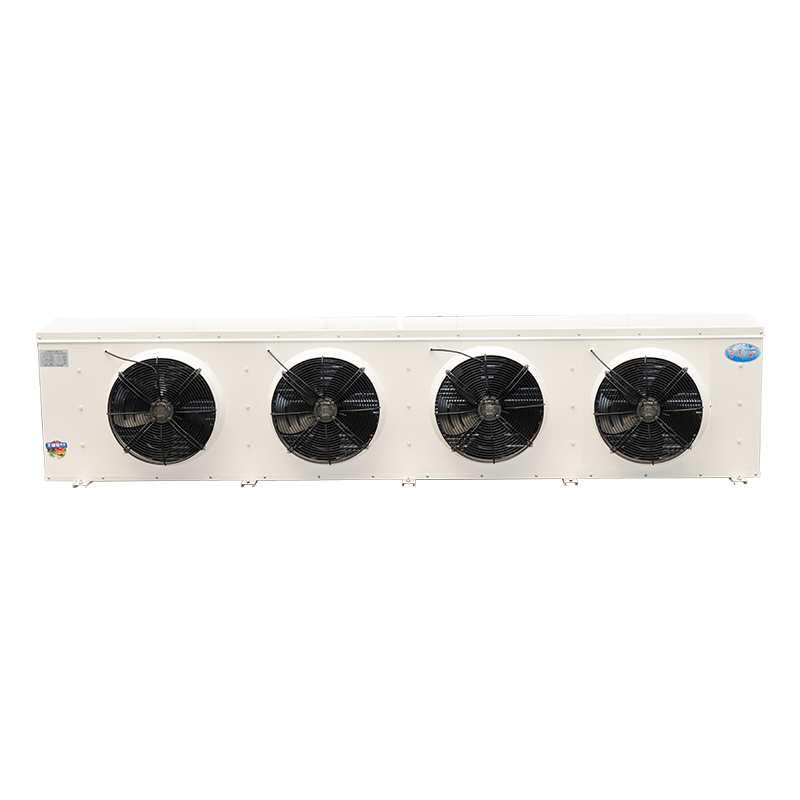 DJ Type Air Cooler for Low-Temperature StorageSuitable for rooms at -25°C or lower, the DJ-type ceiling-mounted air cooler features high-efficiency fans and electric defrost tubes, making it ideal for freezing meat, fish, and pharmaceuticals while ensuring reliable operation in damp conditions.View Product →
Review the complete air cooler selection and maintenance guide before making a final specification.
Frequently Asked Questions
Which air cooler type provides better temperature uniformity?
In rooms wider than 10 meters, a dual-discharge unit generally provides better uniformity because its twin air loops cover both sides of the room. In long, narrow rooms, a single-discharge unit maintains a tighter range with fewer units.
Does a dual-discharge unit consume more energy?
Energy consumption follows fan static pressure and airflow, not the number of outlets. A well-designed dual-discharge unit can move the same air volume at lower fan speed than one large-fan single unit, which often reduces total fan wattage.
What defrost method is fastest for a large frozen storage room?
Hot-gas defrost is usually the fastest at -25 °C because it heats the coil from the inside. Water defrost is efficient when the room is above -5 °C and drain routing can handle the melt water volume.
Can a facility replace single-discharge units with dual-discharge units?
Yes, but the refrigerant distributor, drain pan connections, and ceiling suspension points must be re-evaluated. A dual-discharge unit exposes a different airflow pattern that may leave gaps near existing rack locations.